Checking a Solo Mining Pool: Who Gets What When You Find a Block
By Lukas Henning · 16. November 2026 · 17 min read
On a solo pool, your Bitcoin address sits in the first transaction of the block your miner is working on, the so-called coinbase. If your miner finds that block, the payout is already part of it; the pool never holds a balance for you. That has a useful consequence: what a pool would pay you for a block is written into every job it sends to your miner, so you can check it long before you ever find one.
On 16 November 2026 we did exactly that with five pools that offer solo mining, with Solo CKPool checked on two servers. Our own script logs in like a miner and takes apart the coinbase of the first job. Below are the results, how the mechanism works, the check that AxeOS and NerdOS have had built in since this year, and the one spot where every one of these checks is blind. Which pool suits you, with connection times and all login details, is covered in our solo pool comparison.
What five pools on six servers write into the coinbase
The script connects to each server over Stratum V1, logs in with a test address and waits for the first job, the mining.notify message. From its parts it assembles the coinbase transaction the way a miner does before hashing, then reads every output with its amount and address. It never submits a share.
| Pool (stratum address) | To your address | To a pool address | Fee stated by the pool |
|---|---|---|---|
| AtlasPool (solo.atlaspool.io:3333) | 98.5% (3.0835 BTC) | 1.5% (0.0470 BTC) | 1.5% |
| Parasite (parasite.wtf:42069) | 1.0000 BTC (about 32%) | about 68% (2.1329 BTC), to be shared among the other participants | hybrid model, finder gets 1 BTC |
| pool.opensourceminers.de (:3333), run by us | 100% (3.1331 BTC) | 0% | 0% (SOLO Group: 1%) |
| Public Pool (public-pool.io:3333) | 100% (3.1326 BTC) | 0% | 0% |
| Solo CKPool (stratum.ckpool.org:3333) | 98% (3.0686 BTC) | 2% (0.0626 BTC) | 2% |
| Solo CKPool, server in Germany (eusolo.ckpool.org:3333) | 98% (3.0693 BTC) | 2% (0.0626 BTC) | 2% |
Our own measurement on 16 Nov 2026, 13:05 to 13:08 UTC, block height 976,132, test address from BIP 173. Amounts rounded; total coinbase value 3.1305 to 3.1331 BTC.
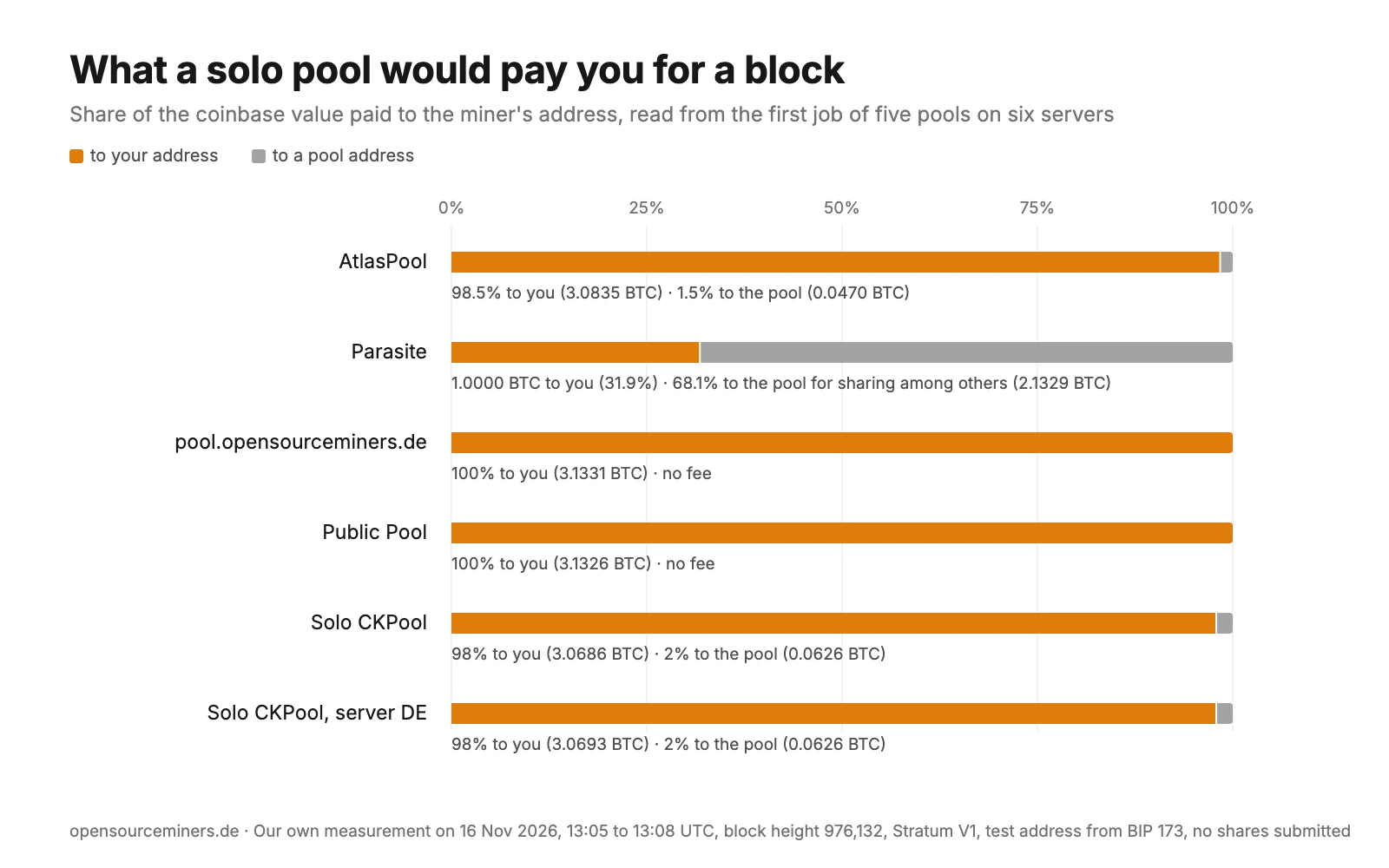
The shares match what the pools publish: 1.5% for AtlasPool according to its terms of service, 2% for CKPool according to its front page, no fee at Public Pool and pool.opensourceminers.de. Both fees are taken from the full coinbase value, block subsidy and transaction fees together. CKPool's 2% goes to exactly the address its front page uses as the example for the username field (bc1q28kkr…fpwfzu). For stratum.ckpool.org, the European server answered our connection in Spain; the pool picks the server with the shortest round trip.
Parasite is not a pure solo pool and describes itself as a hybrid. The finder receives a fixed output of 1 BTC. The rest, about 2.13 BTC that day, goes to a pool address; according to the project, Parasite then pays it out over Lightning to the other participants in proportion to their work. For that part you trust the operator. Mining there trades part of the big win for the prospect of payments from other people's blocks, which is why it does not fit into a single comparable number.
We run pool.opensourceminers.de ourselves and measured it with the same script as every other pool. In pure solo mode the whole block goes to the address in the username field. For SOLO Groups, where several addresses share a find, the pool page states a 1% fee. We did not measure the groups.
Four more test addresses showed whether the pools accept every common address type: legacy (starting with 1), pay-to-script-hash (starting with 3), SegWit for a single key and for scripts (bc1q…) and Taproot (bc1p…). All six servers accepted every type and treated it the same way: identical percentages, and the same fixed amount at Parasite. The SegWit and Taproot test addresses come from the BIP 173 and BIP 350 specifications. They belong to private key 1, which everyone knows, so anyone can spend what arrives there. The legacy and pay-to-script-hash addresses consist of zeros only and have no known key. None of these addresses belongs in your miner.
Two things in the raw data look odd at first and are normal. Every coinbase contains an output with no amount that starts with OP_RETURN: the witness commitment from BIP 141 that every block with SegWit transactions needs. It pays nobody. And the total value differs between pools by a few hundred thousand satoshis. 3.125 BTC is the fixed block subsidy, the rest is transaction fees, and every pool builds its template from its own node's mempool at a slightly different moment. Across our five runs, transaction fees made up between 0.04 and 0.7% of the block value. Right after a new block, the remaining transactions pay very little: at 13:18 UTC the template from pool.opensourceminers.de held several thousand transactions worth just 0.0021 BTC in fees together. Snapshots like these say nothing about which pool earns more in fees.
Why the job fixes the payout
The pool asks its Bitcoin node for a block template: which transactions should go into the next block and what fees they bring. In front of them it places the coinbase, the only transaction whose input points to no earlier output and the one that creates new bitcoin. Its input script carries the block height and counter fields; its outputs are set by the pool. On a solo pool that means your address from the username field and, where applicable, the pool's fee.
The pool sends the coinbase to your miner in two halves, coinb1 and coinb2. Between them sit the two counter fields: the pool assigns extranonce1 per connection, and your miner counts extranonce2 up itself. Add the merkle branch, which ties the coinbase to every other transaction in the block, and the remaining block header fields, and you have one mining.notify message. On pool.opensourceminers.de a new template arrived every 28 seconds on average on 16 Nov 2026: the pool fetches a fresh one every 30 seconds with the latest transactions, and immediately whenever a new block appears.
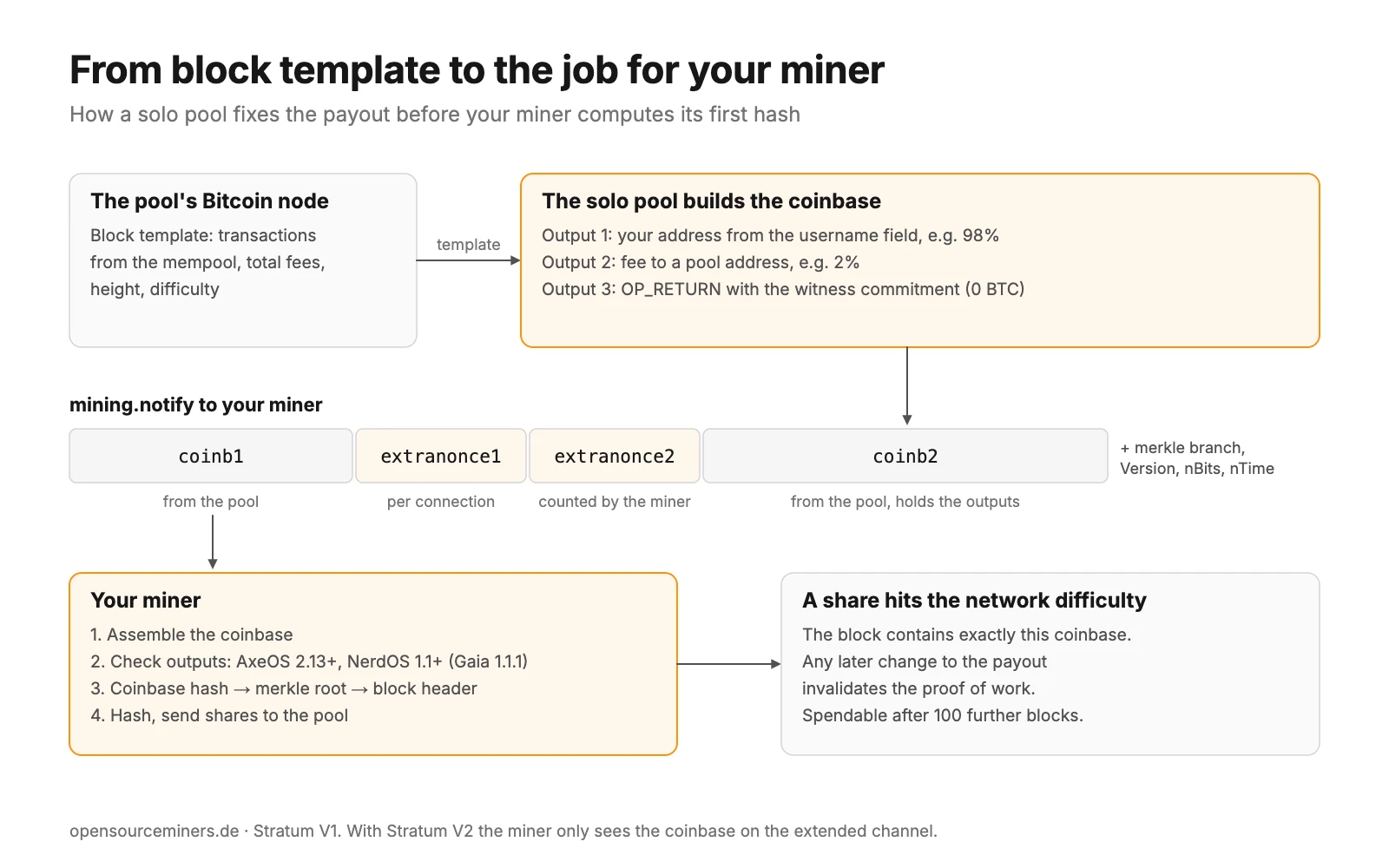
Your miner assembles the coinbase from these parts, hashes it, derives the merkle root, writes it into the block header and starts hashing. This is why the check holds up. The merkle root depends on every single output of the coinbase. If your miner finds a valid header, that proof of work is valid only for exactly this coinbase. If the pool changed a single satoshi of the payout afterwards, the block would be invalid.
There is one thing a pool can still do: not broadcast a block you found. It gains nothing by doing so, and you lose the block. Your miner will tell you that a share reached the network difficulty, but whether the pool broadcast the block only shows up on the blockchain, as described further down. How reliably a pool gets its finds onto the network is shown by its list of found blocks, for the large solo pools on mempool.space, for example.
After a find, the amount appears on your address on the blockchain right away. You can spend it once 100 further blocks have followed. This maturity period is a Bitcoin consensus rule, takes just under 17 hours on average, and protects against coins vanishing from a block that the network, in rare cases, replaces with a competing one.
How your miner checks the coinbase itself
You do not need our script for your own miner. Since 2026, AxeOS and NerdOS take apart the coinbase of every job on their own.
AxeOS from version 2.13.0 (Bitaxe, since February 2026) decodes every job. In the pool section of the dashboard, the "Fee" line shows the share that would go to the pool, as long as you keep at least 95%. If you get less, the line is labelled "Share" and shows your part in red. A warning then appears at the top, in current versions "Your share of the mining reward is only …%" or, if your address is missing entirely, "You don't have a share in the mining reward". The "Block Header" card lists up to six coinbase outputs with their amounts and marks your address with a star. The feature is called "Decode Coinbase Tx" in the advanced pool settings and is on out of the box. You only need to switch it off when mining a chain other than Bitcoin.
NerdOS from version 1.1.0 (NerdQAxe++, NerdOctaxe, NerdQX and Nerdaxe, since late August 2026; for the Nerdaxe Gaia from 1.1.1) goes further. The pool settings have a "Coinbase Verification" checkbox, separately for the primary and the fallback pool, with two modes:
- Basic checks that your address appears in the coinbase. The dashboard then shows it in green.
- Extended also checks a fee limit in percent. If the fee is higher, the address turns red. The preset is 3%; the NerdOS hint mentions ckpool with 3%, while Solo CKPool actually charges 2%.
- Enforce is a checkbox next to the mode. If a pool fails the check, the miner disconnects and only reconnects after you save the settings or restart it. In failover mode it moves to the fallback pool; if every configured pool is blocked, it reports an error.
Out of the box, the check in NerdOS is off. Our recommendation: "Extended" for both pools, with your pool's fee as the limit, so 2 for CKPool, 1.5 for AtlasPool and 0 for a fee-free pool. Switch on "Enforce" once the fallback pool is checked as well and carries your address. On Parasite and in a SOLO Group a large part goes to other addresses by design; AxeOS shows a permanent warning there, and in NerdOS the "Basic" mode is the right choice. In the webhook alert settings you can also enable "Coinbase verification failed", for Discord, for example.
The public device overview of pool.opensourceminers.de shows how widespread the check already is. On 16 Nov 2026 at 12:56 UTC, 648 Bitaxe connections were active there, 521 of them (80%) on AxeOS 2.13 or newer. Of 168 Nerd-family connections, 126 (75%) ran NerdOS 1.1. For the Nerd devices that only means the check is available; it is not switched on out of the box.
Older firmware can be updated in the browser with our firmware flasher. After a factory install, the presets with our placeholder address are back in the fields. So check the pool and username in both fields before you leave the miner running on its own.
The gap no check closes
AxeOS and NerdOS compare the coinbase with the address in your username field. They have no idea where that address came from. If it is a factory address, the pool dutifully pays 100% to it, and the dashboard shows a flawless value. The check tells you whether the pool does what your username field asks for. Whether the field is right is up to you.
That applies to devices from our shop, too. They ship with a preconfigured pool so they start working as soon as Wi-Fi is set up, and both username fields hold an address of ours as a placeholder. Until you replace it, the miner mines for us. AxeOS shows no warning for this; the dashboard even reports a 0% fee in green. So enter your own address in both fields, including the fallback pool's, which is easy to overlook during setup. Then compare the first and last six characters with the receiving address in your wallet.
Out of the box, the fallback field holds pool.opensourceminers.de. For real redundancy, use a pool from a different operator there, such as stratum.ckpool.org or public-pool.io, again with your own address. AxeOS shows the warning "Using fallback pool" while the miner runs on the fallback. How to fill in the fields is explained in our guides setting up a mining pool in AxeOS and setting up a Bitaxe and NerdQAxe.
The fee in euros and in expected value
On 16 Nov 2026 a block was worth about 3.13 BTC. At €58,417 per bitcoin (mempool.space, 12:51 UTC) that is a little over €182,000. 2% of it is about €3,660, 1.5% about €2,740. That is what the fee costs if the rare event happens. How rare it is depends on your hashrate and the difficulty; the pool plays no part in it.
The maths: a device with hashrate h finds on average h ÷ (D × 2³²) blocks per second, where D is the difficulty. On 16 Nov 2026 it stood at 134.82 trillion, equal to roughly 965 EH/s across the network. Scaled up to a year, that gives the expected number of blocks E. The probability of finding at least one block in a year is 1 − e−E, which for values this small is practically E. As hashrate we used the median that devices of each class actually delivered on pool.opensourceminers.de on 16 Nov 2026 at 12:58 UTC, as a one-hour average.
| Device (median at the pool) | Chance of a block per year | Expected value per year | of which 2% fee |
|---|---|---|---|
| Bitaxe with BM1370, mostly Gamma (1.16 TH/s) | 0.0063% (about 1 in 15,800) | about €12 | about €0.23 |
| Nerdaxe Gaia (2.32 TH/s) | 0.0127% (about 1 in 7,900) | about €23 | about €0.46 |
| NerdQAxe++ (4.90 TH/s) | 0.0267% (about 1 in 3,700) | about €49 | about €0.98 |
| NerdOctaxe (11.1 TH/s) | 0.0606% (about 1 in 1,650) | about €111 | about €2.22 |
Our own calculation. Assumptions: difficulty 134.82 T and price €58,417 held constant, block value 3.13 BTC, continuous operation. On 16 Nov 2026 mempool.space expected the next adjustment to raise the difficulty by about 6%.
The expected value is an average over a very long time. Solo mining never pays it out in instalments; you get either nothing or a whole block. What it does show is how little the fee matters on average: for a NerdQAxe++, the difference between a fee-free pool and one charging 2% is about one euro a year in expected value. If the block does fall, it is several thousand euros. Choosing by fee means deciding the outcome of a very rare event, and that can be worth it to you. A pool that is unreachable at the decisive moment, or that pays to the wrong address, still costs more than any fee. Our mining calculator works out the odds for your own device with live figures from the network overview.
What the pool sees of your miner
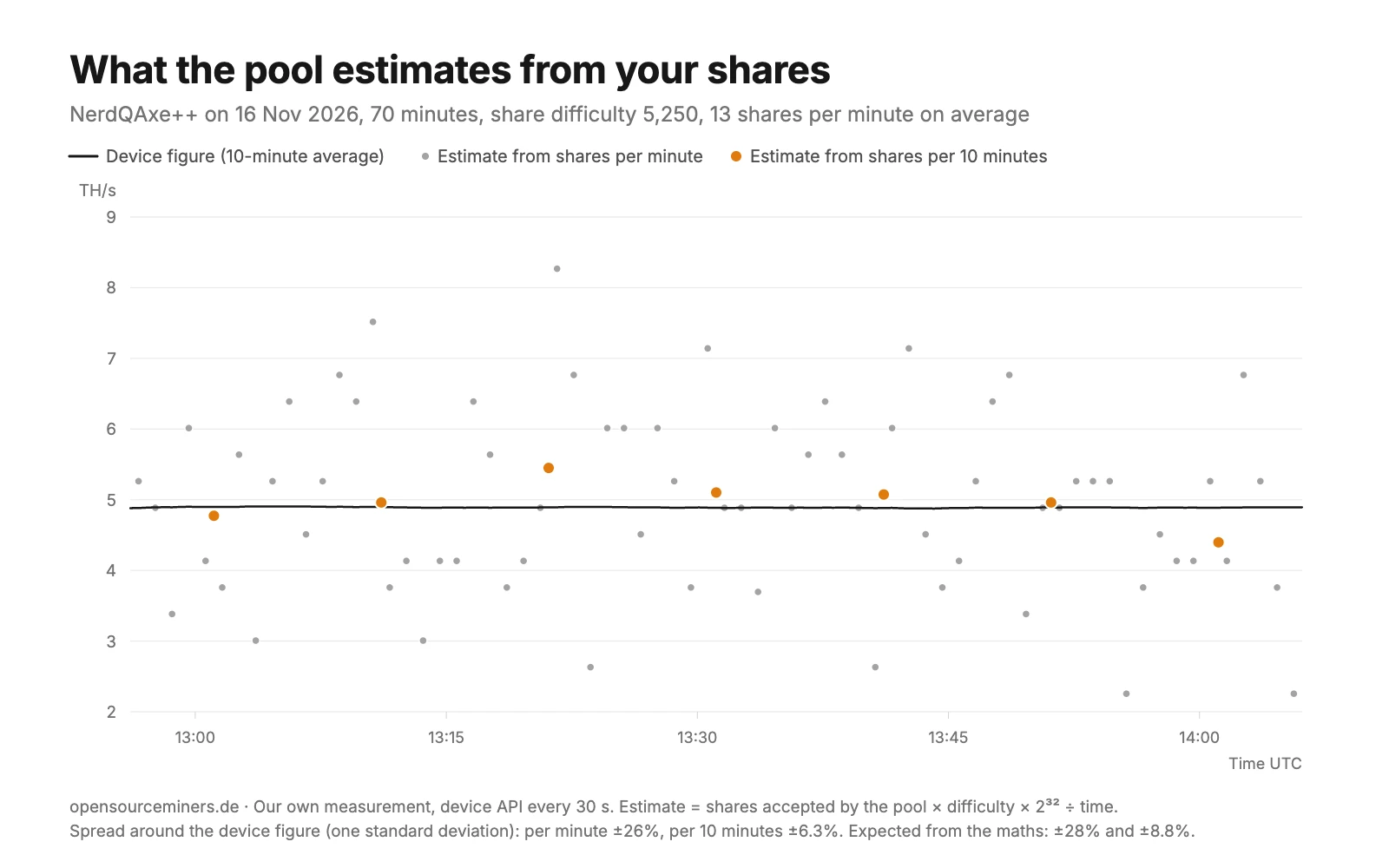
The pool's per-address stats show whether it accepts your work. The hashrate shown there is an estimate from the shares you submit. A share with difficulty d stands for d × 2³² hashes on average. If the pool counts n shares within a time window, it estimates the hashrate as n × d × 2³², divided by the length of the window. Because shares arrive at random, that estimate wobbles by about 1 ÷ √n.
An example: a NerdQAxe++ that runs around the clock on pool.opensourceminers.de at our place, with four BM1370 chips at 600 MHz and 1,150 mV and a share difficulty of 5,250. It submits 13 shares per minute on average. Its firmware, v1.0.37.2-osm.5, still belongs to the 1.0.37 line, which lacks coinbase verification; the same goes for the LTS releases 1.0.37.4 and 1.0.37.5 from October and November 2026.
| Time window | Shares on average | Typical deviation of the pool figure |
|---|---|---|
| 1 minute | 13 | ±28% |
| 5 minutes | 65 | ±12% |
| 1 hour | 781 | ±3.6% |
| 24 hours | 18,700 | ±0.7% |
Our own calculation for 4.89 TH/s and share difficulty 5,250, one standard deviation, fixed time window. Pools running ckpool use moving averages, which read a little steadier. A Bitaxe Gamma at 1.2 TH/s with difficulty 1,000 submits 17 shares per minute, so the same order of magnitude applies.
And this is what we measured: on 16 Nov 2026 the device showed a one-hour average of 4.891 TH/s, and a quarter of an hour later the pool estimated 4.931 TH/s for the past hour. That is 0.8% more, well within the spread in the table. Clock speed and core count give a target of 4.896 TH/s (600 MHz × 2,040 cores × 4 chips). Over the 46 hours the device keeps in memory, the average was 4.891 TH/s, 99.9% of the target. A 70-minute recording shows how much short windows swing: we read the number of shares the pool had accepted from the device every 30 seconds and computed the same estimate a pool makes.
Pools running ckpool, among them pool.opensourceminers.de and Solo CKPool, have one trap. Their one-day and seven-day figures are moving averages that rise only slowly after a restart or a new connection. At the time of measurement the NerdQAxe++ had been connected for 37 hours. The pool showed 3.83 TH/s for 24 hours and 0.97 TH/s for seven days, although the device ran at 4.9 TH/s the whole time. Both figures fit a moving average that has been ramping up for 37 hours. If you compare daily figures after a restart, you will be hunting a fault that does not exist. Use the hourly figure for comparisons.
For rejected shares, the NerdQAxe++ reached 0.206% since its last start (97 of 47,165), and the whole pool 0.205% of submitted work since its restart on 7 Nov 2026. Connection latency explains only a small part of that. After a new block, a miner keeps working on the old one until the new job reaches it. For the NerdQAxe++ with a 78-millisecond response time that is 0.013% of the time on average; for the connection times in our solo pool comparison (34 to 123 milliseconds) it is 0.006 to 0.02%. The stats do not break down where the rest comes from; likely candidates are shares in flight during a reconnect and results the pool rejects as invalid. We consider 0.1 to 0.3% normal. If the rate stays above one percent, check the Wi-Fi signal and the firmware.
"Block found" on the display: how to verify it
Every now and then a miner reports a block that does not exist. The ESP-Miner project documents a case from May 2026: the display showed a find, the pool knew of none. Before you celebrate, check in this order:
- Was it a solo pool? On a regular pool a found block belongs to the pool, and you get your share as usual.
- Is the difficulty high enough? A block needs at least the network difficulty, about 134.8 T on 16 Nov 2026. If the miner's best value is lower, it was not a block.
- Is the block on mempool.space? Around the time of the report, look for the block that pays your address. mempool.space names large pools; blocks from smaller pools such as AtlasPool or pool.opensourceminers.de appear there without a pool name. The next point is what counts.
- Is your address in the coinbase? On the block's page, open the first transaction. Your address must appear among the outputs with the amount the table above leads you to expect.
If all of that checks out, the block is yours.
What the coinbase check does not cover
- Availability: no coinbase tells you whether a pool is up at the decisive moment. That is what the fallback pool is for.
- Broadcasting the block: the pool has to get a find onto the network quickly. How well its node is connected is invisible from the outside.
- Validity of the job: no firmware checks whether the job builds on the current block and is for Bitcoin. Compare block height and network difficulty on the dashboard with mempool.space.
- Choice of transactions: the check compares shares. Whether the pool fills the template with the most rewarding transactions it does not show; at 0.04 to 0.7% of the block value in fees, little money is at stake right now.
- Stratum V2 with a standard channel: here the miner only receives the finished merkle root and no coinbase, so it cannot check anything. That is why AxeOS recommends the extended channel for external pools, where the pool sends the coinbase along.
- Other blockchains: on pools for Bitcoin Cash and similar chains the check means nothing. AxeOS advises switching decoding off there.
The check does catch an attack, as long as it is running. If someone swaps your username on an unencrypted connection, the pool builds the coinbase for the other address. AxeOS then shows the warning on the dashboard, and NerdOS with "Enforce" disconnects. TLS prevents the swap in the first place, and so does Stratum V2 if you enter the pool's authority key; without that key, the miner does not verify whom it is talking to. Which pools offer TLS is listed in our solo pool comparison.
Checklist for your solo pool
- Your own address in both username fields, checked against your wallet.
- A fallback pool from a different operator, also with your address.
- AxeOS 2.13.0 or later, NerdOS 1.1.0 or later, 1.1.1 or later on the Nerdaxe Gaia.
- In NerdOS, coinbase verification set to "Extended" for both pools, limit equal to the pool's fee; "Basic" on Parasite and in SOLO Groups.
- On the AxeOS dashboard, check the "Fee" line: 0%, 1.5% or 2%, matching your pool.
- Compare pool stats using the hourly figure.
How we measured
Coinbase: our own Node.js script without third-party libraries, Stratum V1, one connection per server. Sequence: mining.subscribe, mining.authorize with the test address and password x, first mining.notify after the login was accepted. Coinbase = coinb1 + extranonce1 + extranonce2 (zeros) + coinb2, broken down into outputs (amount, script type, address) and input script (block height per BIP 34). Five runs on 16 Nov 2026 between 13:05 and 13:21 UTC, block heights 976,132 to 976,134, one address type per run. The shares were identical in every run, and at Parasite the fixed amount of 1 BTC. We connected from a line in Spain and submitted no shares.
NerdQAxe++: values from the device API (/api/system/info), read every 30 seconds, plus the history from the device's memory (46 hours in 5-second steps). The pool estimate comes from the pool.opensourceminers.de stats for the same device.
Pool: public device overview of pool.opensourceminers.de (active connections in the last 10 minutes, firmware according to the miner's user agent), 16 Nov 2026 12:56 UTC; median hashrate per device class from the pool server's connection list, 12:58 UTC; templates counted in the pool log, 07:49 to 12:59 UTC. Network: mempool.space, 16 Nov 2026 12:51 UTC. Connection times: solo pool comparison, measured on 28 Oct 2026.
Sources
- Solo CKPool, front page with fee, example address and server selection: solo.ckpool.org (accessed 16 Nov 2026)
- AtlasPool, terms of service: atlaspool.io/terms-of-service.html (accessed 16 Nov 2026)
- Public Pool: web.public-pool.io, source code github.com/benjamin-wilson/public-pool (accessed 16 Nov 2026)
- Parasite: parasite.space, source code github.com/parasitepool/para, description of the model (linked by the project): zkshark.substack.com (accessed 16 Nov 2026)
- AxeOS coinbase decoder: ESP-Miner pull request #1391, included from v2.13.0
- NerdOS coinbase verification: ESP-Miner-NerdQAxePlus pull request #572, included from v1.1.0; Nerdaxe Gaia from v1.1.1
- False "Block found" report: ESP-Miner issue #1688
- BIP 34 (block height in the coinbase): bip-0034; BIP 141 (witness commitment): bip-0141; BIP 173 and BIP 350 (address formats, test addresses): bip-0173, bip-0350
- 100-block maturity: Bitcoin Core, src/consensus/consensus.h (COINBASE_MATURITY)
- Stratum V1, structure of mining.notify: Stratum mining protocol, Bitcoin Wiki
- Network data and price: mempool.space/mining (accessed 16 Nov 2026, 12:51 UTC)
Frequently asked questions
Does a solo pool pay out regularly?
Can a pool take a block I found?
Which address type should I use?
Why does the pool show less hashrate than my miner?
When can I spend a block I found?
Do I need Stratum V2 for the check to work?
Is pool.opensourceminers.de really fee-free?
Written by
Lukas Henning · Mining editor and hardware expert
Lukas has been working with Bitcoin mining for years and runs several open-source miners such as Bitaxe and NerdQaxe at home. For Open Source Miners he tests hardware and turns his setups into guides you can follow step by step on your own device.
All guides by Lukas Henning →

