Bitcoin Mining with Solar Power: Turning Balcony Solar and PV Surplus into Hashrate
By Lukas Henning · 25. September 2026 · 17 min read
Anyone running a balcony solar kit or a rooftop system knows the picture in the inverter dashboard: at noon production sits at 600 or 700 watts, but only the fridge and the router are running. The rest flows into the grid, and with a balcony kit that usually means without a cent of compensation. In the evening, when the stove and the TV are on, you buy the same electricity back at around 37 cents per kilowatt-hour. Bitcoin mining with solar power targets exactly that gap: a small miner absorbs the surplus nobody pays for and turns it into hashrate.
The topic is usually calculated with industrial miners that draw 3,000 watts and would never run on any balcony. We take the other route. This guide works with devices between 15 and 220 watts, meaning the hardware that actually fits into a flat and behind an 800-watt inverter. You will learn what a kilowatt-hour is worth in a miner today, which miner fits which system, how to let it run with the sun automatically, and where the limits are. All figures are from 25 September 2026 and come with sources so you can check them yourself.
Three prices for the same kilowatt-hour
The whole appeal of solar mining comes from one simple fact: in your household a kilowatt-hour does not have one price but three, depending on when and where it occurs.
- Grid supply: According to the BDEW electricity price analysis, a German household pays an average of 37.0 cents per kilowatt-hour in 2026. New-customer tariffs sit a little below that, default supply above it.
- Feed-in: If your system is registered for compensation, systems up to 10 kWp commissioned from August 2026 receive 7.70 cents per kilowatt-hour for partial feed-in according to the Federal Network Agency. The rate drops by about one percent every six months.
- Given away: Most balcony kits run without a feed-in contract. Their surplus goes into the grid for 0 cents. And since the Solar Peaks Act of February 2025, new larger systems no longer receive compensation during hours with negative exchange prices either.
This leads to the most important rule in this article, and it applies to every miner no matter how efficient: solar power you could consume yourself belongs in the washing machine, the heat pump or the battery, not in the miner. Every kilowatt-hour of self-consumption saves you 37 cents. No miner in the world gets 37 cents out of a kilowatt-hour. The miner only competes with the 7.70 cents of feed-in or the 0 cents of giving it away. And that is exactly where it wins, as we will see.
What a kilowatt-hour is worth inside a miner
To compare miner and feed-in fairly you need the return per kilowatt-hour. It depends on two things: the current state of the Bitcoin network (price, network hashrate, block reward) and the efficiency of your device in joules per terahash (J/TH). Efficiency is the lever you control. A miner at 10 J/TH gets almost twice as much Bitcoin out of the same kilowatt-hour as one at 18 J/TH.
The maths is short. On 25 September 2026 the network hashrate stood at around 930 EH/s according to mempool.space, the price at about 73,700 euros, and the block reward at 3.125 BTC excluding fees. One terahash per second therefore earns around 0.00000048 BTC per day in pool mining, roughly 3.6 cents per TH/s and day. That gives a handy rule of thumb:
This is how it looks for the devices we sell ourselves and know from continuous operation. All values are pool-mining expected values before pool fee; the power draw is the typical value in the factory configuration.
| Miner | Hashrate | Power | Efficiency | Return per day | Return per kWh |
|---|---|---|---|---|---|
| Nerdaxe Gaia | ~2.6 TH/s | ~25 W | ~10 J/TH | ~9.3 ct | ~15.5 ct |
| Bitaxe Copperzilla | ~1.3 TH/s | ~15 W | ~12 J/TH | ~4.6 ct | ~12.9 ct |
| Bitaxe Gamma 601 | ~1.3 TH/s | ~17 W | ~13 J/TH | ~4.6 ct | ~11.4 ct |
| NerdOctaxe Hydro | ~14 TH/s | ~220 W | ~16 J/TH | ~50 ct | ~9.5 ct |
| NerdQaxe ++ | ~4.8 TH/s | ~80 W | ~17 J/TH | ~17 ct | ~8.9 ct |
| NerdOctaxe | ~12 TH/s | ~200 W | ~17 J/TH | ~43 ct | ~8.9 ct |
| Bitaxe GT 801 | ~2.15 TH/s | ~40 W | ~19 J/TH | ~7.7 ct | ~8.0 ct |
| Avalon Nano 3S | ~6 TH/s | ~140 W | ~23 J/TH | ~21 ct | ~6.4 ct |
| For comparison: feed-in | 7.70 ct | ||||
| For comparison: grid supply | 37.0 ct |
Pool-mining expected values on 25 Sep 2026 at ~930 EH/s network hashrate and ~€73,700 per BTC, before pool fee. The values change daily with price and difficulty.
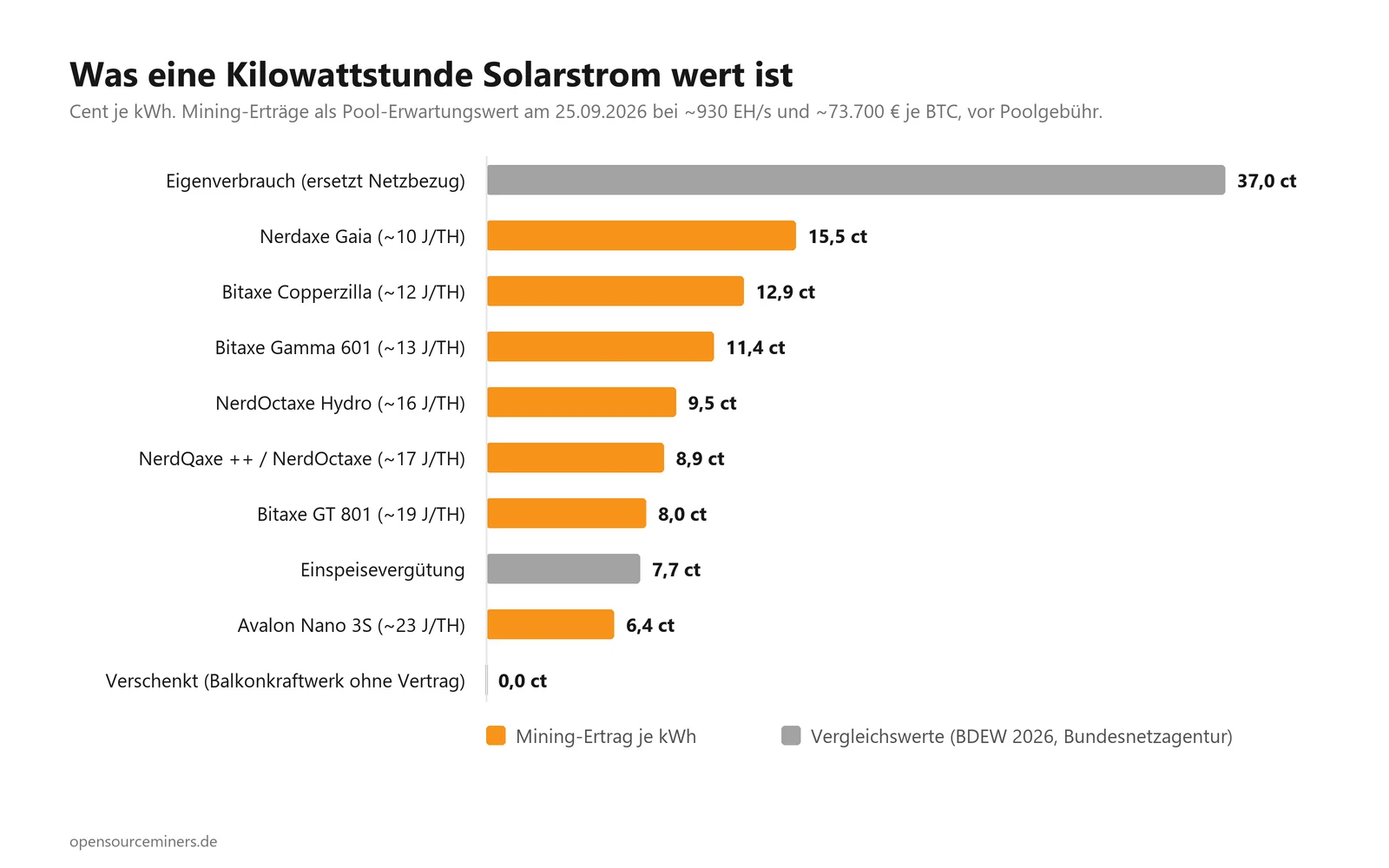
The table shows three things at a glance. First: efficient miners with BM1370 or BM1373 chips sit clearly above the feed-in tariff. A kilowatt-hour you put into a Nerdaxe Gaia brings about twice as much as the same kilowatt-hour in the grid. Second: no device comes anywhere near the 37 cents of grid supply. Solar mining only pays with electricity you would not otherwise use yourself. Third: the absolute amounts are small. A Bitaxe Gamma earns around 17 euros a year in a pool, a NerdOctaxe Hydro around 180 euros. If you hope for more, you have to bet on the solo block, more on that later.
A word on pool fees: large pools take one to two percent of the return. Our own solo pool charges no fee, but there is no running return there, only the chance of a whole block. Our solo pool comparison helps you decide which variant suits you.
Which miner fits which system
The second question is size. A miner that permanently draws more than your system delivers as surplus runs on grid power most of the time, and then it loses money. The rule of thumb: the miner's power draw should sit clearly below the typical midday surplus, not below the peak output of the system. The surplus is production minus the base load of your household, and in most flats that base load is between 100 and 300 watts.
| System | Typical midday surplus | Suitable miners | Annual miner consumption |
|---|---|---|---|
| Balcony kit, 1 module (~450 Wp) | often 100 to 250 W | Bitaxe Gamma 601, Bitaxe Copperzilla, Nerdaxe Gaia | 130 to 220 kWh |
| Balcony kit, 2 modules (800 W inverter) | often 300 to 600 W | plus Bitaxe GT 801, with throttling also NerdQaxe ++ | 350 to 700 kWh |
| Rooftop system 3 to 5 kWp | usually above 1,000 W | NerdQaxe ++, NerdOctaxe | 700 to 1,750 kWh |
| Rooftop system from 6 kWp, battery full at noon | several kilowatts | NerdOctaxe Hydro, several devices | from 1,900 kWh |
Guide values for sunny days from April to September. In winter the surplus is considerably lower for all systems.
For the balcony class the small open-source miners are close to ideal. A Bitaxe Gamma 601 draws around 17 watts, as much as a bright LED lamp. A single 450-watt module covers that on an overcast day, and on a sunny day with an enormous buffer. The Nerdaxe Gaia at around 25 watts with the new BM1373 chip is the most efficient miner in our range and therefore the best choice if you want the maximum out of every kilowatt-hour. The Bitaxe GT 801 at around 40 watts still fits a two-module kit well, but its efficiency trails the single-chip devices.
The NerdQaxe ++ at around 80 watts is the borderline case on the balcony. On clear summer days it runs for several hours entirely on sunshine; in the morning and afternoon it draws grid power. This is where throttling via AxeOS pays off: with lower frequency and voltage the power draw drops noticeably, efficiency even improves, and the miner fits under the surplus again. Our AxeOS tuning guide explains how. NerdOctaxe and NerdOctaxe Hydro at 200 to 220 watts belong on a rooftop system. There they are the most interesting devices, because they stay efficient at around 16 J/TH and serve as a small supplementary heater in winter.
The balcony kit: 800 watts, one miner and the rest of the household
Because most readers of this article own or plan a balcony solar kit, the framework deserves a closer look. Since the German Solar Package I of May 2024, a plug-in solar device may have up to 2,000 watts of module power according to the Federal Network Agency, while inverter output is capped at 800 volt-amperes in total. Registration is now done only in the Market Master Data Register; registering with the grid operator is no longer required. And since autumn 2024 tenants in Germany have a claim under § 554 of the Civil Code that the landlord must in principle tolerate a balcony kit.
As for yield: an 800-watt balcony kit in Germany delivers roughly 500 to 900 kilowatt-hours a year depending on orientation and tilt. A module hanging vertically on a north-facing balcony sits at the lower end, two south-facing tilted modules at the upper end. The plug-in solar simulator of HTW Berlin calculates the value for your location, including the self-consumption share. Without a battery, households typically use only a good half of the electricity they generate themselves. The rest, 200 to 400 kilowatt-hours a year, is the surplus this article is about.
Put that into proportion: a Bitaxe Gamma needs around 150 kilowatt-hours a year, a Nerdaxe Gaia around 220. Both therefore fit into the surplus of an ordinary balcony kit on paper, even if you run them around the clock. A NerdQaxe ++ at around 700 kilowatt-hours a year clearly exceeds the surplus; on the balcony it only pays throttled and during the day.
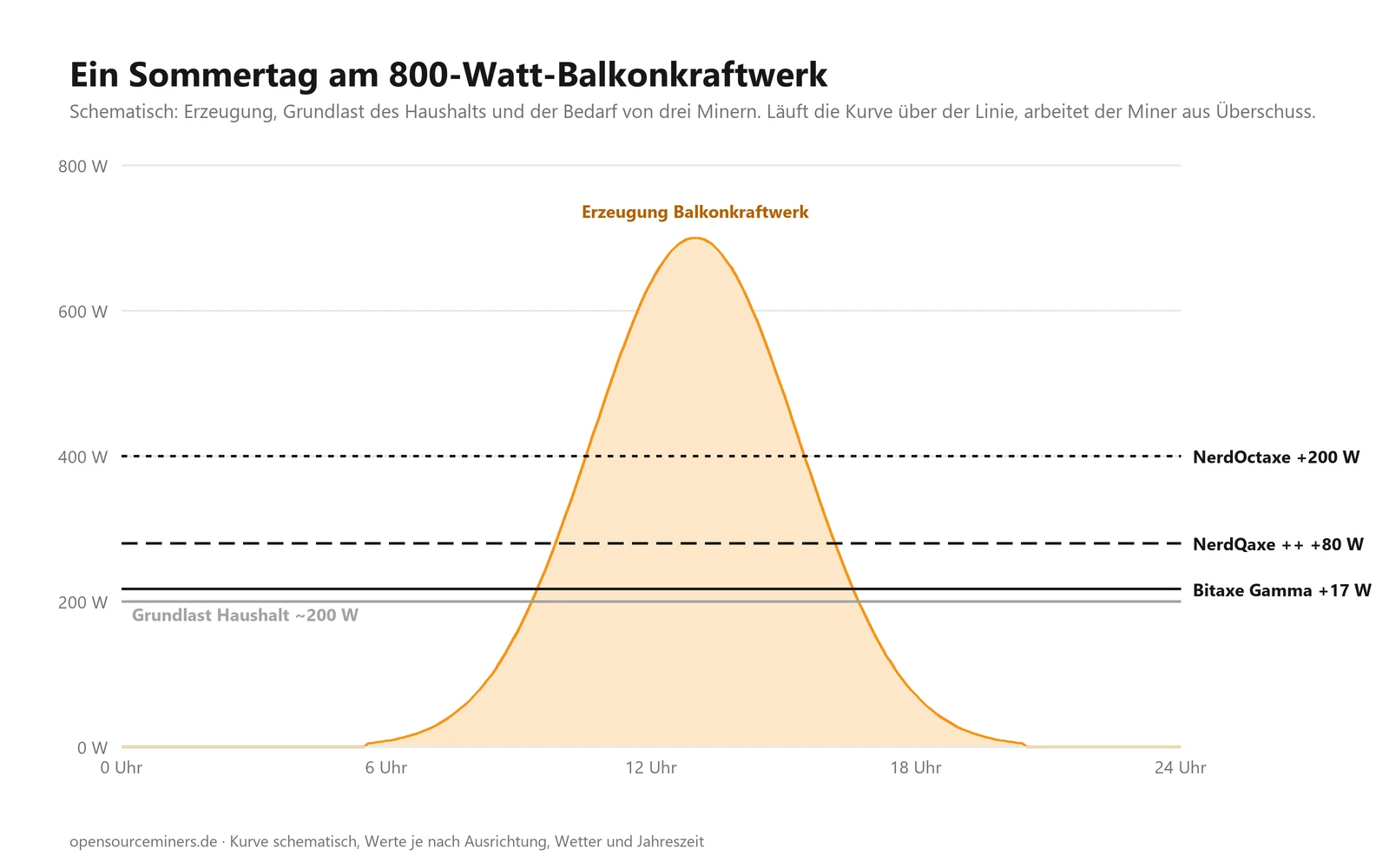
One point that is often misunderstood: the 800-watt inverter limits feed-in, not your consumption. You can run miners drawing 1,000 watts on the same power strip; the inverter then delivers its 800 watts and the meter takes the rest from the grid. Electrically that is perfectly fine, economically it is exactly what you want to avoid. The art lies in keeping consumption below production, and for that you need either a small miner or a control system.
Three operating modes: net balance, schedule, surplus
There are three ways to run a miner on solar power. They differ in effort and in how much grid power actually ends up in the miner.
- Net balance, around the clock: The miner always runs. Over the year the system produces more than the miner consumes. At night and in winter it still runs on grid power at 37 cents, and on summer days you keep giving surplus away. Simple, but economically the weakest option, because the expensive night hours count in full. For a 17-watt miner the damage of around 2 euros of grid power a month is manageable; for a NerdOctaxe it is not.
- By schedule: A switchable socket lets the miner run only between about 10 a.m. and 4 p.m., shorter or not at all in winter. Ten minutes of setup, no sensors. It does not match the sun every day, but most days. For Bitaxe and Nerdaxe on the balcony this is the best compromise between effort and result.
- By surplus: A controller continuously measures what the system delivers and what the household draws, and switches or throttles the miner accordingly. More involved, but the only option where truly only surplus ends up in the miner. For NerdQaxe ++ and larger it is mandatory if the numbers are to work.
Which option you choose depends on the device. The larger the miner relative to the system, the more important the control. With the 17-watt Bitaxe you can afford to be generous; with the 200-watt NerdOctaxe every hour on grid power costs around 7 cents, and there are many of those in a year.
Making the miner follow the sun: the implementation
This is where the real advantage of open-source miners lies. AxeOS, the firmware of Bitaxe, Nerdaxe, NerdQaxe and NerdOctaxe, provides an open interface for reading and controlling the miner. You do not depend on a manufacturer app; you can connect any home automation. We show three levels, from the simplest to the most precise.
Level 1: switchable smart socket with metering. A WiFi socket with power metering, such as a Shelly Plug S or a comparable device, costs around 20 euros and brings two things: a schedule and a display of what the miner actually draws. Set the schedule to the sunny hours, in summer roughly 9 a.m. to 5 p.m., in autumn 11 a.m. to 3 p.m., in winter possibly not at all depending on your system. The miner starts by itself after power-on, connects to WiFi and resumes work at the pool within a minute. Frequent switching on and off does not harm the devices; they are built for unattended operation.
Level 2: Home Assistant with production and consumption data. If you run Home Assistant, you can make the miner follow real surplus. You need three data sources: current production, current house consumption and the miner itself. Many inverters provide production through their own integration; for the widespread Hoymiles micro-inverters there is OpenDTU, an open-source project that exposes the values via MQTT and REST and is auto-discovered by Home Assistant. House consumption comes from a reading head on the electricity meter or a three-phase energy meter in the distribution board. You connect the miner with the AxeOS HA Integration (MIT licence, installable via HACS, developed for Bitaxe and Nerdaxe; NerdQaxe and NerdOctaxe speak the same AxeOS API). It provides hashrate, power and temperatures as sensors and frequency, core voltage and fan as controllable entities.
The automation is then a handful of rules: if the surplus (production minus consumption without the miner) stays above the miner's power for five minutes, switch it on or raise the frequency. If it drops below for five minutes, throttle or switch off. The five minutes matter: without this hysteresis the controller flips back and forth with every cloud. Throttling is almost always preferable to switching off. A throttled Bitaxe keeps running at better efficiency and delivers shares to the pool continuously; a switched-off one needs a few minutes after start-up until the hashrate is back.
Level 3: the AxeOS interface directly. If you prefer to write your own script, you talk to the miner through its HTTP API, documented in the ESP-Miner project as an OpenAPI description. Three calls are enough for surplus control: GET /api/system/info returns power, hashRate and temp among other things. PATCH /api/system accepts JSON with frequency and coreVoltage and applies the new values. Newer AxeOS versions additionally offer POST /api/system/pause and POST /api/system/resume to halt mining without cutting power to the device. A Python script on a Raspberry Pi that polls the inverter every 60 seconds and adjusts the frequency is written in an evening.
If you have a dynamic electricity tariff, you can add a second condition to the same automation: miner on when the exchange price of the current hour is below the return per kilowatt-hour. In hours with negative exchange prices, of which the Federal Network Agency counted 573 in 2025, your unit price drops considerably; because of grid fees and taxes it only falls below zero in exceptional cases. Those hours almost always fall at midday when the sun is shining anyway.
Miner, battery or feed-in: the honest calculation
That leaves the question of whether a battery would be the better use for the surplus. The short answer: yes, if you consume enough in the evening to empty the battery. The long answer is still worthwhile, because it shows where the miner has its place.
Take a balcony kit with 2 kilowatt-hours of surplus on a summer day. A battery with around 2 kilowatt-hours of usable capacity shifts about 1.7 kilowatt-hours of that into the evening after losses and replaces grid power at 37 cents: around 63 cents a day, but only on days with surplus, so roughly 150 to 200 days a year. At a purchase price of 800 to 1,200 euros it pays back in eight to twelve years. A Nerdaxe Gaia takes 0.6 kilowatt-hours from the same surplus and turns them into around 9 cents of pool return, on every day it runs. At 199 euros that is around six years to payback in continuous operation, and considerably longer if it only runs on surplus. The battery clearly wins per kilowatt-hour; the miner is cheaper to buy and has no capacity limit: once the battery is full at noon you give power away again, while the miner keeps running.
| Use of the surplus | Value per kWh | Limit | Also |
|---|---|---|---|
| Shift self-consumption (washing machine at noon) | 37 ct | only what you consume anyway | costs nothing, always first |
| Battery storage | 37 ct minus ~15 % losses | capacity, needs an empty battery in the evening | €800 to €1,200 purchase |
| Efficient miner (10 to 13 J/TH) | 11 to 15 ct | none, runs on any surplus | €139 to €199 purchase, chance of a solo block, waste heat |
| Feed-in with compensation | 7.70 ct | only with registration, rate drops every six months | no purchase |
| Give away | 0 ct | none | the normal case for a balcony kit |
Ranking for the use of solar surplus. The miner sits behind self-consumption and battery, but ahead of feed-in and giving away.
The ranking is clear, and we would not dress it up for you: first self-consumption, then battery, then miner, then feed-in. The miner is the right choice for the surplus left after the first two stages, for households that do not want a battery, and for anyone who wants to take part in the Bitcoin network without paying for grid power to do it. In that role it is unbeatably cheap: a Bitaxe costs a fraction of a battery and needs no space in the basement.
And then there is the solo block. All returns above are pool expected values. If you mine on a solo pool instead, you forgo the running return and bet on the chance of finding a whole block worth 3.125 BTC plus fees. At 930 EH/s network hashrate the probability for a Bitaxe Gamma is around one in 13,000 per year, for a NerdOctaxe Hydro around one in 1,300. That is a lottery, and solar power makes the ticket free. Our article Lottery miner explained shows how this calculation works.
Winter, night and waste heat
Solar mining has an annual rhythm you should know. From May to August a balcony kit often delivers three to four times per day what it manages in December. In winter the surplus on many days is not even enough for a Bitaxe, and the sunny hours lie between 10 a.m. and 2 p.m. If you control the miner by surplus, you will see it run little in winter. That is not a fault of the controller but the right decision: putting grid power at 37 cents into a miner that makes 11 cents out of it does not pay.
There is one exception, and it is relevant: waste heat. Every kilowatt-hour a miner takes in, it gives back to the room almost entirely as heat. If you would heat electrically in winter anyway, say with a fan heater in the home office or a frost guard in the garden shed, the miner is the better electric heater: the same heat plus 9 to 15 cents of mining return per kilowatt-hour. A NerdOctaxe Hydro gives off around 220 watts, as much as a small towel radiator, and its water cooling keeps it quiet. Against a gas heating system or a heat pump it clearly loses, because a kilowatt-hour of heat costs only 9 to 12 cents there.
At night the same applies as in winter. Without a battery there is no solar power, and the miner runs on the grid. For a 17-watt Bitaxe that is around 6 cents a night, which many owners accept deliberately to keep the solo chance around the clock. For anything above 40 watts you should switch the miner off or throttle it at night. The schedule from level 1 handles that automatically.
Tax and registration in brief
Two formalities belong in every honest guide, even if they rarely have practical consequences for a Bitaxe on a balcony. We are not tax advisers; the following points describe the German legal situation but do not replace advice.
- Balcony kit: The system is entered in the Market Master Data Register of the Federal Network Agency within one month of commissioning. Five details, ten minutes, free of charge. Whether you also connect a miner makes no difference to the registration.
- Mining returns: According to the Federal Ministry of Finance letter of 6 March 2025, Bitcoin from mining is valued at the market price at the time of receipt. For private mining without a commercial structure it counts as other income under § 22 no. 3 of the Income Tax Act. There an exemption limit of 256 euros per calendar year applies: if all other income together stays below it, no tax is due. A Bitaxe with 17 euros of pool return a year is far below that, a NerdOctaxe Hydro with around 180 euros still just below.
- The solo block: If your miner finds a block, 3.125 BTC arrive at once, currently around 230,000 euros. That is taxable in the year of receipt at the price on that day. Anyone mining solo should think that through once and, if it happens, see a tax adviser immediately.
- Trade: One or two small miners in a private flat are, according to everything the tax authorities and specialist literature write about it, generally not a commercial business. Anyone buying several large devices and systematically aiming for profit moves into a different category and should have that clarified beforehand.
Typical mistakes
- Sizing by peak output: 800 watts on the label does not mean 800 watts of surplus. Work with the midday value minus base load, and plan the miner below that.
- Forgetting power supply losses: The miners' power figures are values at the socket, the power supply is included. But if you retrofit an oversized or cheap power supply, you quickly lose 10 to 15 percent. Plug in a metering socket and measure.
- Too large a miner on the balcony: A NerdOctaxe on a balcony kit runs on grid power most of the time. Start small; a second Bitaxe is quickly added if the surplus allows.
- Switching without hysteresis: A controller that reacts to every cloud switches the miner dozens of times a day. A five-minute delay in both directions calms the system.
- Wrong expectations: A Bitaxe earns cents per day in a pool. If you expect a return on the purchase, a battery is the better calculation. If you want to run a piece of Bitcoin infrastructure without paying for grid power, you are in the right place.
- Underestimating WiFi on the balcony: The miner often sits where WiFi is weak. A dropped pool connection costs hashrate without you noticing. Our setup guide shows how to check the connection.
Conclusion: the right place for the miner
Bitcoin mining with solar power is not a way to make money with a balcony solar kit. It is a way to turn electricity you would otherwise give away into something that belongs to you: hashrate, a small running Bitcoin return or the chance of a block, plus a little warmth in winter. In that role an efficient open-source miner beats the feed-in tariff today by one and a half to two times, costs a fraction of a battery and can be made to follow the sun with twenty euros of accessories.
In concrete terms: on a balcony kit, a Bitaxe Gamma 601 or a Nerdaxe Gaia on a scheduled socket, done. On a rooftop system it can be a NerdQaxe ++ or a NerdOctaxe with surplus control. And if you have no system of your own but like the idea, our guide to mining without your own power hookup has the alternatives. Our miner comparison shows which device suits you; what running it on grid power would cost is in the electricity cost guide.
Frequently asked questions
Is Bitcoin mining with a balcony solar kit worth it?
Which Bitcoin miner fits an 800-watt balcony solar kit?
How much electricity does a Bitaxe use per year?
Can I run the miner automatically only on solar surplus?
Is throttling or switching off better when the sun fades?
What is better for the surplus: battery or miner?
Do I have to pay tax on mining returns from solar power?
Can I use the miner as a heater in winter?
Written by
Lukas Henning · Mining-Redakteur & Hardware-Experte
Lukas beschäftigt sich seit Jahren mit Bitcoin-Mining und betreibt mehrere Open-Source-Miner wie Bitaxe und NerdQaxe im eigenen Zuhause. Für Open Source Miners testet er Hardware, dokumentiert Setups und übersetzt Mining-Technik in verständliche Anleitungen: praxisnah, ehrlich und ohne Hype.


