NerdOctaxe Hydro as a Supplementary Heater: What 220 Watts of Waste Heat Really Do in Winter
By Lukas Henning · 16. October 2026 · 16 min read
Every Bitcoin miner is an electric heater. Of the 220 watts a NerdOctaxe Hydro draws from the socket, practically all of it arrives in the room as heat; the difference from a fan heater is that on the way there the miner computes around 14 TH/s and gets paid for it. With the start of the heating season the same question therefore comes up every year: can I heat with the miner, and is it worth it? The answer has two parts. Physically yes, without restriction. Economically only where you would otherwise heat with electricity. This guide works out both, with the figures from autumn 2026 and without marketing promises: 220 watts are a supplementary heater for one room, not a replacement for the heating system.
We take the NerdOctaxe Hydro as the example because it is the miner with the most waste heat in our range and because its water cooling makes it suitable for living spaces. For the NerdOctaxe (around 200 watts) and the NerdQaxe ++ (around 80 watts) the same calculations apply with smaller numbers. The mining returns are from September 2026 (network hashrate around 930 EH/s, price around 73,700 euros); how they come about is in the guide Bitcoin mining with solar power.
Electricity becomes heat, completely
The first law of thermodynamics is your friend here: electrical energy that a device takes in and does not emit as light, radio or mechanical work becomes heat. A miner emits almost nothing. The WiFi signal is in the milliwatt range, the display too, and the computing work itself leaves the device only as information over the network and carries no energy. Of 220 watts of intake, 220 watts of heat remain, spread across chips, voltage regulators, power supply and pumps. A fan heater at 220 watts delivers exactly the same amount of heat, no more. The efficiency of an electric heater is always 100 percent, and so is a miner's.
The difference is not in the heat but in the by-product. A fan heater turns a kilowatt-hour of electricity into a kilowatt-hour of heat. A NerdOctaxe Hydro turns the same kilowatt-hour into a kilowatt-hour of heat plus around 9.5 cents of Bitcoin return in pool mining, as of September 2026. That is the whole idea, and it is so simple that the temptation to overrate it is great. The restriction follows immediately: it only holds against other electric heaters. Against gas, oil, district heating or a heat pump, the electricity the miner needs is so expensive that the mining return does not close the gap.
Which room 220 watts heat
Heating engineers size radiators by the heat load, meaning the heating power a room needs on the coldest day of the year to hold its target temperature. As a rule of thumb, depending on insulation, 50 to 100 watts per square metre apply at normal ceiling height: 50 in a well-insulated new build, 100 in an uninsulated old building. A 12-square-metre home office thus has a heat load of 600 to 1,200 watts. By that calculation, 220 watts are just enough for a well-insulated room of 2 to 4 square metres, and that is exactly how the question is usually answered in forums: too little, forget it.
That answer is right for the coldest day and wrong for the rest of the winter. The heat load is calculated for an outdoor temperature of about minus 12 degrees, which Germany reaches on a few days a year. A room's heat demand falls in proportion to the temperature difference between inside and outside. Take the 12-square-metre room with a 600-watt heat load at minus 12 degrees and 20 degrees room temperature, a 32-kelvin difference. At 5 degrees outside, an ordinary day in November, the difference is 15 kelvin and the demand only around 280 watts. At 10 degrees, as on many October and March days, it is around 190 watts. In both cases the Hydro covers the demand fully or almost fully; the radiator stays cold.
| Outdoor temperature | Heat demand of the example room | Share covered by 220 W | What that means |
|---|---|---|---|
| +10 °C (October, March) | ~190 W | 100 % | miner heats alone, radiator stays off |
| +5 °C (November, February) | ~280 W | ~80 % | miner carries almost everything, radiator rarely kicks in |
| 0 °C (December, January) | ~375 W | ~60 % | miner halves the radiator's consumption |
| −5 °C (cold week) | ~470 W | ~45 % | miner is a supplementary heater |
| −12 °C (design day) | ~600 W | ~35 % | miner is a supplementary heater |
Example room: 12 m², well insulated, heat load 600 W at −12 °C and 20 °C inside. Demand scales with the temperature difference. For an old building at 100 W/m² the shares halve.
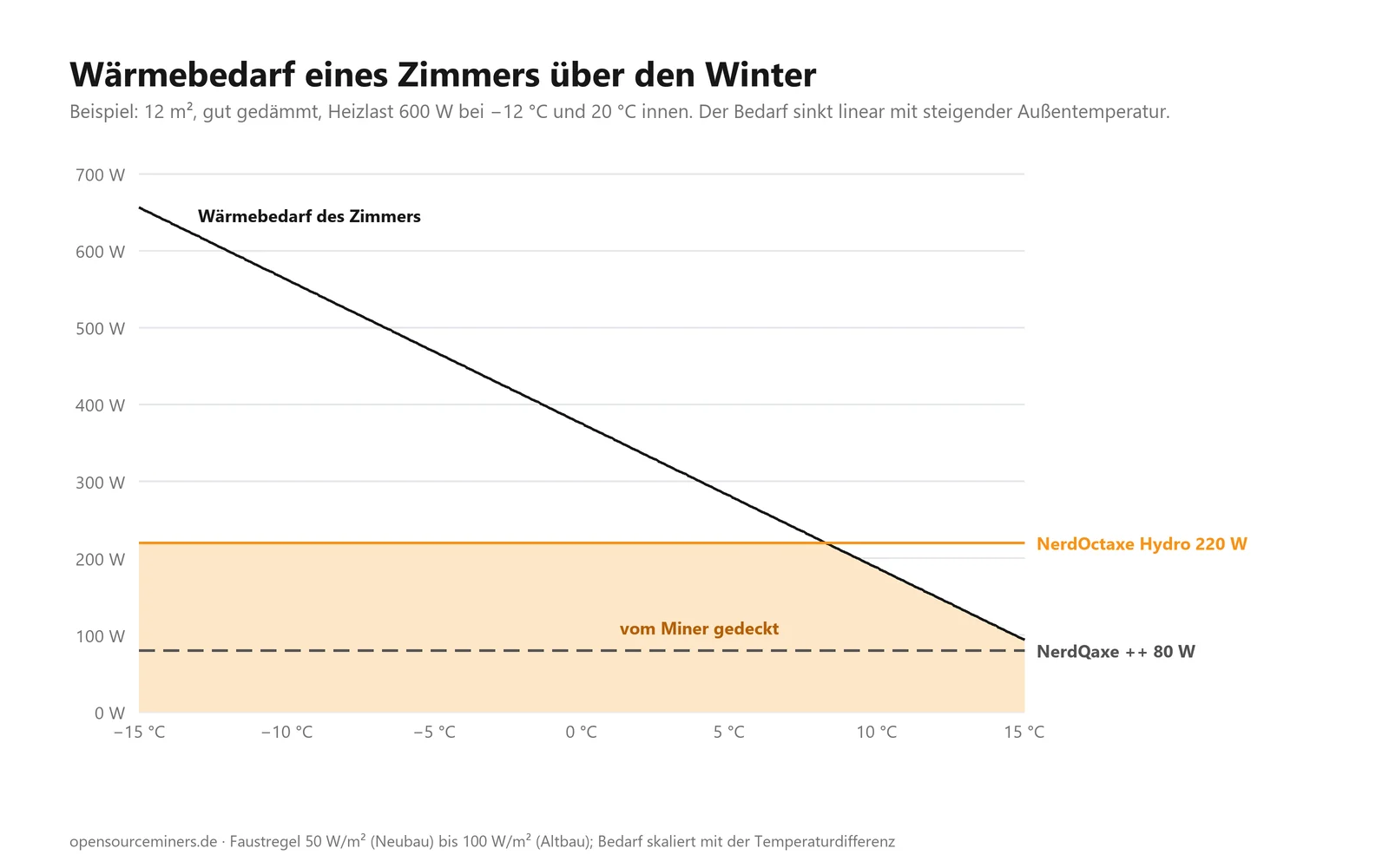
Two things to keep in mind. First, the miner heats only the room it stands in, and only well if the heat stays there: door closed, window closed. Second, the calculation only works with continuous operation. A radiator delivers 600 watts when needed and nothing when not. The miner delivers 220 watts as long as it runs, and it needs hours. It is a base-load heater: it keeps the room at temperature instead of heating it up quickly. That suits rooms in constant use, not the guest room that should be warm once a week.
For comparison with the devices sold as "Bitcoin heaters": the Ofen from 21energy in Austria delivers 800 to 1,100 watts depending on the model and is advertised for rooms up to 32 to 55 square metres, with 10 to 60 TH/s and prices from around 2,000 euros. That is the class that heats a whole room alone even in January. The NerdOctaxe Hydro plays one class below: a quarter of the heating power, a quarter of the hashrate, a good third of the price, and unlike the Ofen, open hardware with AxeOS that you can control and tune yourself.
Why the water cooling makes the difference
An air-cooled miner at 200 watts needs a powerful fan directly on the heatsink, and that fan is what you hear in the room. The NerdOctaxe Hydro solves this with two all-in-one water coolers of the kind that sit on the processor in gaming PCs: four BM1370 chips each sit under a cooling block with an integrated pump, the heat travels through hoses into two radiators, and there large, slowly turning fans pass it to the room air. Large fan areas at low speed are the reason the device stays comparatively quiet for its performance class. The loops are closed and factory-filled; you refill nothing and connect nothing. The heat ends up entirely in the room air, not in water; there is no connection to the house heating.
For heating operation this dictates the right placement: the radiators need free air on both sides, so do not push the miner into a shelf or behind a curtain. It is best placed where the radiator usually works, near the window, so the warm air shields the cold window surface. And it belongs on a firm base, because the pumps can draw air when tilted. The supplied stand takes care of that. If you throttle the miner via AxeOS, power and heat drop equally; the fan speed follows the chip temperature and falls with it.
Dosing the heat: throttle levels as heat settings
A fan heater has two or three settings; a miner with AxeOS has as many as you like. A chip's power draw depends on clock frequency and core voltage, and disproportionately on the voltage: roughly, power rises with frequency and with the square of the voltage. If you lower both together, power falls faster than hashrate, efficiency improves and the heat decreases. That is why throttling is the royal road when heating: the miner keeps running, delivers work to the pool continuously, and you set the heat the way the room needs it.
In practice you prepare two or three pairs of frequency and voltage that you have tested by hand once: the factory setting as full heat, a pair well below it as half heat and a very low pair as frost guard. Which values are safe for the NerdOctaxe is in the AxeOS tuning guide; you read the power in the AxeOS dashboard, and the heat matches it. The important thing is always to lower both values together. Reducing only the frequency while leaving the voltage high saves hardly any power, because the voltage share is the larger lever. If you have home automation, let room temperature choose the level; if not, set it in the dashboard in the morning.
What a kilowatt-hour of heat costs
Now to the calculation that decides. A kilowatt-hour of heat costs very different amounts depending on the heating system. The household electricity price in 2026 averages 37.0 cents according to the BDEW; a kilowatt-hour of gas costs around 12 cents including the standing charge; a heat pump with a seasonal performance factor of 4 on a heat pump tariff turns 1 kilowatt-hour of electricity into 4 kilowatt-hours of heat and thus comes to 7 to 9 cents; district heating sits at around 14 cents. The miner takes the electricity price and subtracts its return.
| Heat source | Cost per kWh of heat | Note |
|---|---|---|
| Fan heater, infrared panel, storage heater (daytime rate) | ~37 ct | household electricity, BDEW 2026 |
| NerdOctaxe Hydro on grid power | ~27.5 ct | 37 ct minus ~9.5 ct pool return |
| NerdOctaxe Hydro on a dynamic tariff, cheap night hours | ~15 to 18 ct | at ~25 ct unit price at night, assumption |
| District heating | ~14 ct | 2026 average, varies a lot by network |
| Gas heating | ~11 to 12 ct | incl. standing charge, efficiency included |
| Heat pump, SPF 4, heat pump tariff | ~7 to 9 ct | since 2026 without CHP and offshore levies |
| NerdOctaxe Hydro from solar surplus | below 0 ct | electricity would otherwise be given away, return remains |
Cost per kilowatt-hour of heat, as of autumn 2026, rounded. Mining return in pool mining at ~930 EH/s and ~€73,700 per BTC; it changes daily.
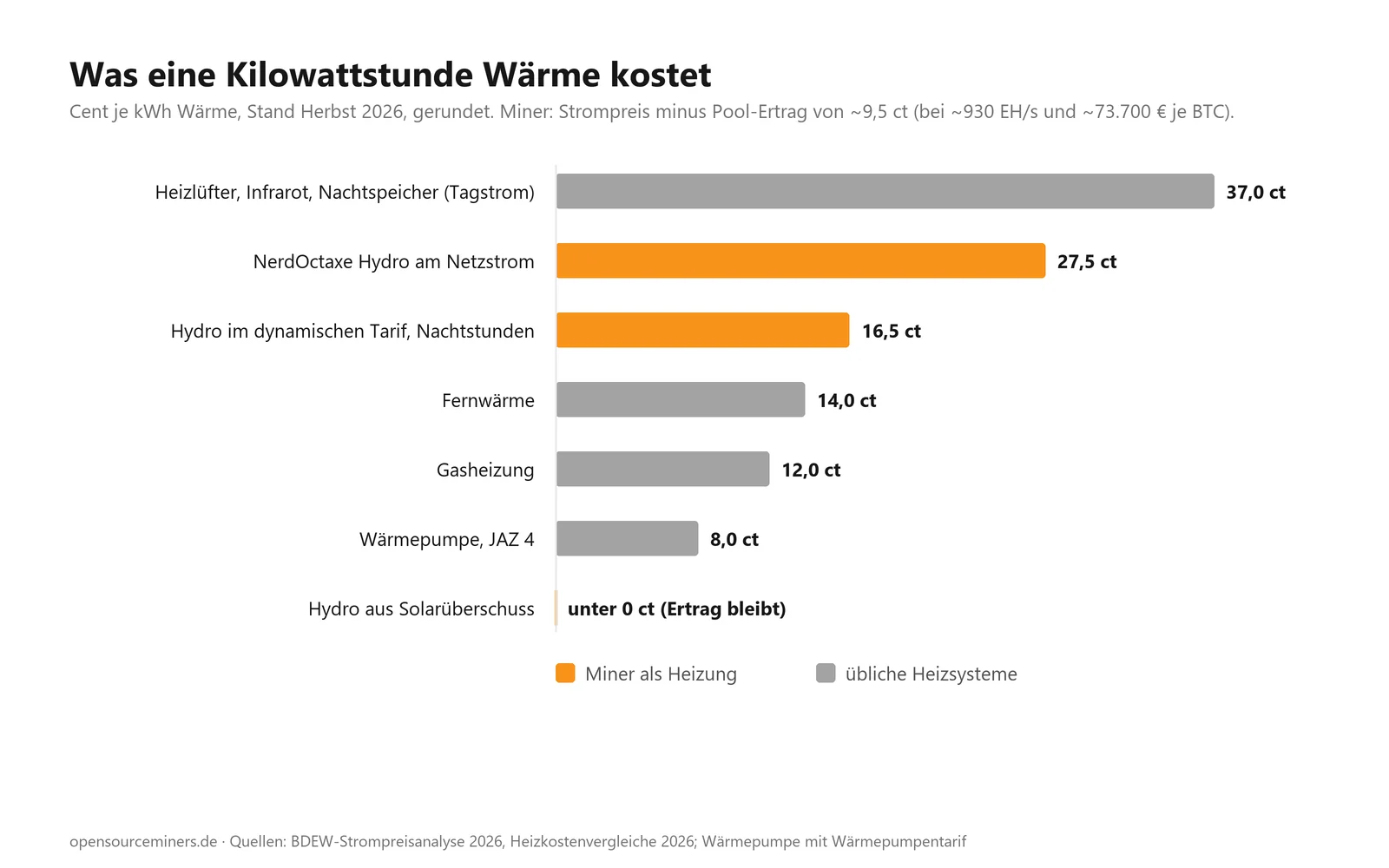
The table answers the question of worth precisely. Against every other electric heater the miner wins, by exactly its return: it heats for 27.5 instead of 37 cents, a quarter cheaper. Against gas it loses clearly, against the heat pump by a wide margin. If you have gas heating and run the miner as a heater, you pay around 15 cents more for every kilowatt-hour of heat from the miner than for the same heat from the radiator. You can do that, because you want the miner running anyway and the heat is then at least not wasted. But it is not a heating decision; it is a mining decision with a heat bonus.
Two special cases turn the calculation around. On a dynamic tariff the night kilowatt-hour in windy nights costs well below average, and at night the room cools down anyway; a miner that heats only at night then comes close to district heating. What such a tariff brings for miners and where its limits are is in the guide Bitcoin mining with a dynamic electricity tariff. And with your own solar surplus the heat is not only free but paid for. However, in winter, when the heat is needed, there is little surplus; that is the great weakness of any combination of photovoltaics and heating, and the miner cannot resolve it.
For whom the miner as a heater pays
A clear list follows from the table. The miner as a heater pays wherever heating is done with electricity today and no heat pump is involved:
- Rooms without radiators: converted attic, hobby room in the basement, extension, conservatory. Instead of a fan heater or infrared panel the miner stands there, and the heat costs a quarter less.
- Garden shed, workshop, garage: Where a frost guard or a fan heater keeps the room above freezing, a miner does the same with the same electricity, and it likes it cool.
- Caravan and tiny house on shore power: electrically heated, small enough for 220 watts, and often with solar on the roof anyway.
- Rented flats with storage heaters or electric heating: Here the miner is the cheapest kilowatt-hour of heat there is, as long as the landlord has no objections.
- The home office in a gas-heated house that has a miner anyway: Here the heat does not pay, but it is there; if you already run the NerdOctaxe, put it in winter where the heat is useful and turn the radiator thermostats down half a degree.
The miner as a heater does not pay if the purchase is to be justified by the heat alone. 799 euros for 220 watts of heating power is many times what a fan heater costs, and the saving of 9.5 cents per kilowatt-hour only recovers that after many years at 500 kilowatt-hours of heat per winter (around 48 euros). The calculation only works if you want the miner as a miner and take the heat as a bonus, or if heating season and solar summer together make a year in which it does both.
A winter with the Hydro: the worked example
How much is on the bill at the end of a winter is shown by a worked example for the 12-square-metre home office from above, in a house that otherwise heats electrically. Heating season from October to April, around 200 days. On those days the miner runs an average of 12 hours, controlled by room temperature, so around 2,400 hours. It draws 528 kilowatt-hours and gives off the same amount as heat.
| Item | Fan heater 220 W | NerdOctaxe Hydro |
|---|---|---|
| Run time in winter | 2,400 h | 2,400 h |
| Electricity consumption | 528 kWh | 528 kWh |
| Heat in the room | 528 kWh | 528 kWh |
| Electricity cost (37 ct) | ~€195 | ~€195 |
| Pool return | €0 | ~€50 |
| Cost of the heat | ~€195 | ~€145 |
| Solo instead of pool: block chance this winter | about 1 in 4,600 |
One winter in the electrically heated home office, 2,400 operating hours, pool mining, as of September 2026. The solo block chance refers to the 2,400 hours at ~930 EH/s.
The 50 euros of savings are no fortune, but they are real, every winter, and they rise with the Bitcoin price. If you mine solo instead of in a pool, you forgo the 50 euros and buy a ticket instead: at 14 TH/s and 2,400 hours the chance of a whole block worth 3.125 BTC is about one in 4,600. That is the calculation our article Lottery miner explained works through in detail. For the heat it does not matter which path you choose; it arrives in both cases.
The miner as thermostat: the control
For the miner to work like a heater it needs a rule that a heater has: it runs when the room is too cold and pauses when it is warm enough. The simplest implementation is a thermostat socket of the kind sold for fan heaters, with a sensor in the room and an adjustable target temperature. It switches the miner hard off and on; it tolerates that, and after switching on it is back at full hashrate within one or two minutes. More elegant is throttling via AxeOS, because the miner then does not go off when the target temperature is reached but keeps running at lower power and better efficiency.
If you run Home Assistant, build the room temperature into the automation we described in the tutorial Controlling a Bitcoin miner with Home Assistant as a condition: room below 19 degrees, miner full; room between 19 and 21 degrees, miner throttled; room above 21 degrees, miner off. Add a window contact that pauses the miner while airing, and on a dynamic tariff the rule to shift the heat into the cheap night hours. With a hysteresis of half a degree and a five-minute cycle this runs all winter without intervention.
Summer: when the heat is a nuisance
The flip side of heating is summer. 220 watts that are welcome in January turn the home office into a sauna in July. If you want to run the miner all year, you need a plan for the warm months, and there are three. The first is relocation: in summer the miner moves to the basement, the garage or a covered balcony, where the heat does not bother anyone and the ambient temperature even suits the chips. Check WiFi range first. The second is throttling: at the lowest level the Hydro gives off only a fraction of its heat and keeps computing at its best efficiency. The third is solar surplus: if you have a system, let the miner run in summer only when the sun supplies the electricity, and then you heat with solar power, which is warm but free; how that works is in the guide Bitcoin mining with solar power.
From the annual cycle follows the operating pattern that suits a 220-watt miner in Germany best: from October to April in the living space as a heater, controlled by room temperature; from May to September throttled in a cool place or by solar surplus. That way it runs all year without ever being a nuisance, and in every season the heat is either useful or negligible.
One large miner or several small ones?
For heat distribution a single 220-watt miner is not always the best solution. If you heat two rooms electrically, two NerdQaxe ++ at 80 watts each, or one NerdQaxe ++ and one Bitaxe, often serve you better than one Hydro in one room: the heat arises where it is needed, and each device can be controlled individually. The price is somewhat worse efficiency per terahash, because smaller devices with one power supply and one controller per chip have more overhead, and more fan noise in total. For one room the Hydro remains the better choice, because the water cooling removes 220 watts more quietly than two air coolers together.
What no home miner can do should also be clear. It heats air, not water: hot water, underfloor heating and the house's heating circuit remain out of reach, because the Hydro's closed cooling loops have no heat exchanger to the house system and 220 watts would be too little for a buffer tank anyway. Devices that do this are industrial miners with several kilowatts in special enclosures, and they play in a different price and noise class. And it does not heat faster than a fan heater of the same power: if you want a cold bathroom warm in ten minutes in the morning, you need 2,000 watts for that, not 220.
One difference from infrared heating matters for comfort. An infrared panel gives off its heat as radiation; it warms walls, furniture and people directly, and a room feels warm at a lower air temperature. The miner heats like a fan heater by convection: the fans blow warm air out of the radiators, which rises and spreads through the room. That warms the air quickly, the walls slowly. For a desk near the radiators that is pleasant; for a whole room it takes time. A small fan that circulates the air distributes the heat more evenly and costs three watts.
Practice and safety
- Power supply and socket: The supplied power supply delivers 12 volts at 20 amperes, so 250 watts. It gets warm and belongs in free air, not under the carpet and not in a drawer. An ordinary power strip handles the load without problems, but the miner should not hang on the same strip as another fan heater.
- Dust: Radiators are dust traps. Once a month go over the fins with a brush or vacuum cleaner, otherwise cooling performance drops and the fan spins faster.
- Do not cover anything: If you want to make the miner "cosier" and put a cloth over it, the heat builds up, AxeOS throttles or shuts down, and the heating power is gone. The miner needs free air like every radiator.
- Smoke detector: A miner is no fire risk in normal operation, but it is a 220-watt device that runs unattended. A smoke detector in the room is mandatory, as with every electric heater.
- Humidity: Electric heaters do not dry the air, that is a myth; they only warm it, which lowers the relative humidity. That applies to the miner as much as to the radiator. If you have dry air in winter, you have it with every heater.
- Noise: The Hydro is audible, especially at night in the bedroom, but considerably quieter than an air-cooled miner of the same power. Whether it suits a bedroom is a matter of taste; for home office, workshop and hobby room it is unproblematic.
Tax and the fine print
The pool return of one winter is around 50 euros, that of a whole year in continuous operation around 180 euros. Both stay below the exemption limit of 256 euros that applies in Germany to other income under § 22 no. 3 of the Income Tax Act, provided no other such income is added. If the miner finds a solo block, that is different: 3.125 BTC are taxed in the year of receipt at the day's price, and then the case belongs to a tax adviser. The Federal Ministry of Finance letter of 6 March 2025 describes the treatment; we are not tax advisers, and this paragraph does not replace advice. For tenants: a miner is an electrical appliance like a fan heater and needs no permission; electric heating as the main heating may be regulated in the tenancy agreement.
Conclusion
The NerdOctaxe Hydro is a 220-watt electric heater that gets paid for its heat: around 9.5 cents per kilowatt-hour, as of September 2026. That makes it the cheapest electric heater you can buy, and the only one with a chance of 3.125 BTC. It replaces neither gas heating nor a heat pump, because their heat costs a third to a quarter. But it keeps a well-insulated room warm on its own over large parts of the heating season, and in the cold weeks it takes half the work off the radiator. If you heat electrically anyway or mine anyway, put the miner in winter where the heat is useful, control it by room temperature, and in summer, when the heat is a nuisance, switch to solar surplus or throttling.
If you need less heat and less hashrate, the NerdQaxe ++ at around 80 watts is the smaller variant of the same principle, good for a bathroom or guest toilet. And if you want to run the miner exclusively as a heater and without your own hardware, a fan heater serves you better; the miner only pays if you want both. Which devices give off how much heat is shown in the power draw column of the miner comparison.
Frequently asked questions
Can you heat with a Bitcoin miner?
Which room do 220 watts heat?
What does a kilowatt-hour of heat from the miner cost?
Does the miner as a heater pay compared with gas heating?
Why is the NerdOctaxe Hydro water-cooled?
How do I control the miner by room temperature?
How high is the chance of a solo block with the Hydro?
Written by
Lukas Henning · Mining-Redakteur & Hardware-Experte
Lukas beschäftigt sich seit Jahren mit Bitcoin-Mining und betreibt mehrere Open-Source-Miner wie Bitaxe und NerdQaxe im eigenen Zuhause. Für Open Source Miners testet er Hardware, dokumentiert Setups und übersetzt Mining-Technik in verständliche Anleitungen: praxisnah, ehrlich und ohne Hype.


