Bitcoin Mining with a Dynamic Electricity Tariff: When Tibber and Co. Should Switch the Miner On
By Lukas Henning · 09. October 2026 · 16 min read
Since the beginning of 2025 every electricity supplier in Germany has had to offer a dynamic tariff, and since the exchange switched to quarter-hour prices in October 2025 the electricity price changes 96 times a day. In home-mining forums the topic is therefore everywhere: if electricity costs nothing on the exchange at midday or is even negative, a Bitcoin miner on a dynamic electricity tariff should finally run profitably. The short answer: only in a few hours a year, and even then only with an efficient device. The long answer is this guide, and it is worth it because it shows when the dynamic tariff still helps the miner and which rule you should enter in your control system.
We use the figures from September 2026: network hashrate around 930 EH/s, price around 73,700 euros, block reward 3.125 BTC. From that follows what a kilowatt-hour is worth in a miner; the derivation is in the guide Bitcoin mining with solar power. All tariff components come from the Federal Network Agency and the BDEW. If you take away only one number, make it this one: of an exchange price of zero, around 20 cents per kilowatt-hour remain for the end customer. That is the hurdle every miner has to clear.
How a dynamic tariff works
A dynamic tariff passes the wholesale price of the electricity exchange on to you. The price is formed the day before in the day-ahead auction of EPEX Spot: around noon the prices for all quarter-hours of the next day are fixed, since 1 October 2025 in 96 blocks instead of 24 hours. Your supplier takes that price, adds grid fees, taxes, levies and its margin, and bills your consumption quarter-hour by quarter-hour. That is the difference from a fixed-price tariff, where the supplier carries the price risk and charges a premium for it.
Two prerequisites matter, and the second is often overlooked. First: since 1 January 2025 all suppliers are obliged under § 41a EnWG to offer a dynamic tariff; Tibber, aWATTar, Octopus, Ostrom, Rabot, 1Komma5° and many municipal utilities do so. Second: quarter-hourly billing requires an intelligent metering system, meaning a smart meter with gateway installed by the metering point operator. Without a smart meter, suppliers bill your monthly consumption at the monthly average price. Then it makes no difference at all to your bill whether your miner runs at noon or at midnight. Price control achieves nothing in that case, except that you test the logic in advance. Tibber, for instance, explains in its support article on the smart meter rollout that fully dynamic billing needs the smart meter and that a newly connected Pulse no longer serves as the billing basis since mid-2026.
What gets added to the exchange price
The exchange price is only part of what you pay, and not even the largest. The BDEW electricity price analysis 2026 breaks the average household price of 37.0 cents per kilowatt-hour down into 15.2 cents for procurement and sales, 9.2 cents grid fees and 12.6 cents taxes, levies and surcharges. In a dynamic tariff the exchange price replaces the procurement share; everything else stays. In 2025 the day-ahead price averaged 89.32 euros per megawatt-hour according to the Federal Network Agency, meaning 8.9 cents per kilowatt-hour.
| Component | ct/kWh | Depends on the exchange price? |
|---|---|---|
| Day-ahead exchange price (2025 average) | ~8.9 | yes, this is the dynamic part |
| Grid fees (2026 average) | ~9.2 | no |
| Electricity tax, concession fee, levies, VAT | ~12.6 | no (VAT only partly) |
| Supplier margin and standing charge, apportioned | ~1.5 to 3 | no |
| Total at average exchange price | ~32 to 34 | |
| Total at exchange price zero | ~20 to 22 |
Components of a kilowatt-hour in a dynamic tariff, rounded. Sources: BDEW electricity price analysis 2026, Federal Network Agency. Grid fees and levies differ by region by several cents.
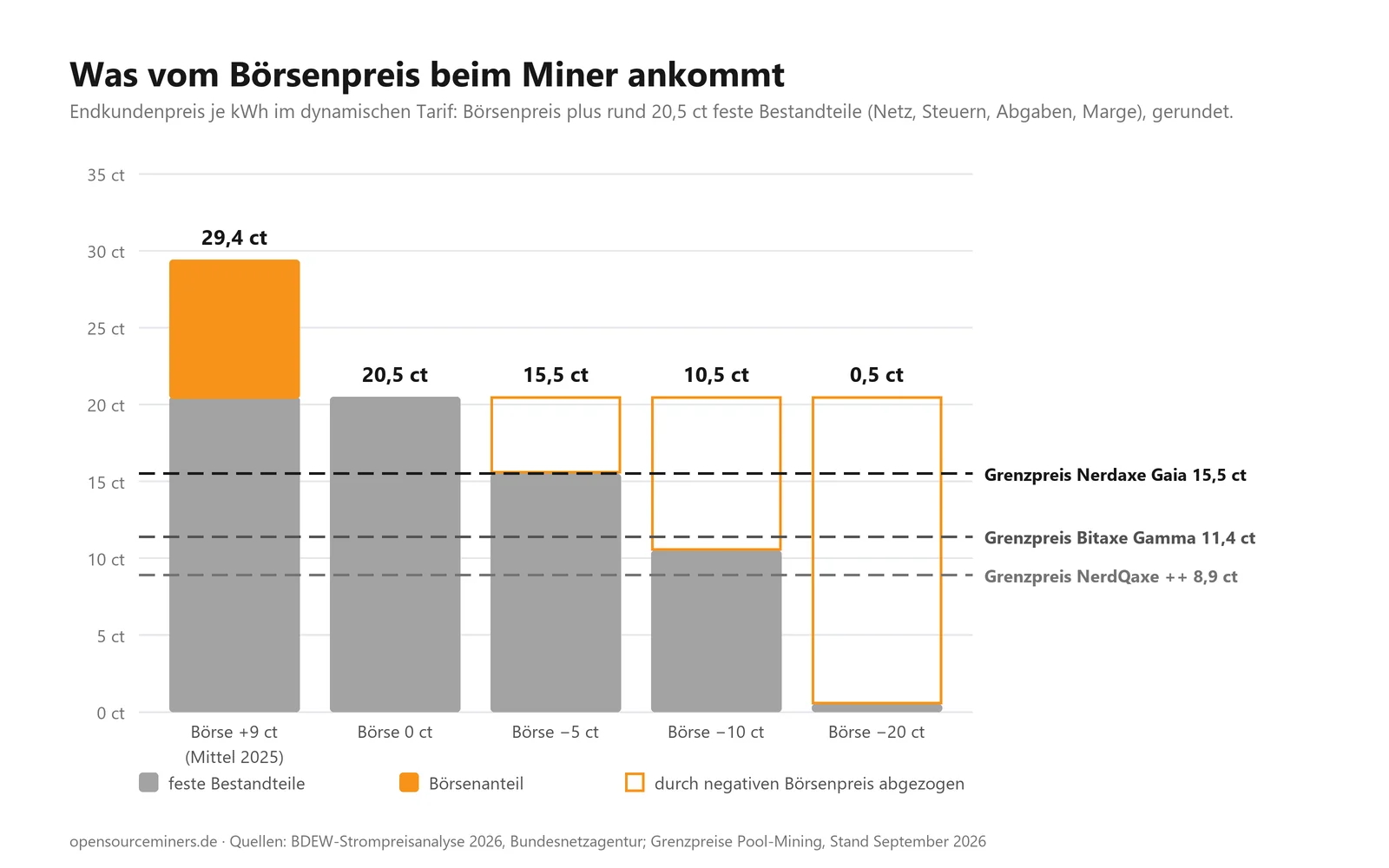
That settles the calculation for the much-cited negative prices. In 2025 there were 573 hours with a negative wholesale price according to the Federal Network Agency, a good six percent of the year. In those hours a dynamic tariff credits you the negative price, but you keep paying the 20 cents for grid, taxes and levies. At an exchange price of minus 5 cents the kilowatt-hour therefore costs you around 15 cents, at minus 10 cents around 10 cents. The supplier actually paying you for consuming only happens at exchange prices below about minus 20 cents, and in Germany those are exceptional hours on a few Sundays in spring and summer.
Your miner's threshold price
On the other side of the calculation is what the miner makes of the kilowatt-hour. That depends on its efficiency in joules per terahash and on the state of the Bitcoin network. With the September 2026 figures, one terahash per second earns around 3.6 cents a day in a pool; from that follows the return per kilowatt-hour and thus the threshold price: the electricity price up to which running from the grid at least covers its cost.
| Miner | Efficiency | Threshold price (pool) | Exchange price at which it pays |
|---|---|---|---|
| Nerdaxe Gaia | ~10 J/TH | ~15.5 ct | below about minus 5 ct |
| Bitaxe Copperzilla | ~12 J/TH | ~12.9 ct | below about minus 8 ct |
| Bitaxe Gamma 601 | ~13 J/TH | ~11.4 ct | below about minus 9 ct |
| NerdOctaxe Hydro | ~16 J/TH | ~9.5 ct | below about minus 11 ct |
| NerdQaxe ++, NerdOctaxe | ~17 J/TH | ~8.9 ct | below about minus 12 ct |
| Bitaxe GT 801 | ~19 J/TH | ~8.0 ct | below about minus 13 ct |
| Avalon Nano 3S | ~23 J/TH | ~6.4 ct | below about minus 14 ct |
Threshold prices in pool mining, as of September 2026, before pool fee. The last column assumes around 20.5 cents of fixed components; depending on the grid area it shifts by a few cents.
The last column is the real finding of this article. Even the most efficient miner in our range, the Nerdaxe Gaia, needs an exchange price below minus 5 cents for grid operation to break even. A Bitaxe Gamma needs minus 9 cents, a NerdQaxe ++ minus 12 cents. Of the 573 negative hours of 2025, most were only slightly negative, a few cents below zero, and not deep enough. How many hours a year really fell below minus 10 cents you can look up for your grid area on SMARD, the data portal of the Federal Network Agency; it is dozens, not hundreds.
You can recalculate your device's current threshold price at any time with our mining calculator: return per TH/s and day in cents times 1,000, divided by 24 times efficiency in J/TH. If the price rises, the threshold rises; if difficulty rises, it falls. As a rule of thumb for 2026: the threshold price for good devices lies between 8 and 16 cents and thus always below what a German household pays for grid electricity even in the cheapest hours.
When the miner should run anyway
If pure grid mining never breaks even, why a dynamic tariff for miners at all? Because the threshold price only applies when the miner runs for the Bitcoin return alone. In three situations the calculation is different, and each has its own switch-on price.
| Situation | What the kilowatt-hour brings in addition | Switch-on price |
|---|---|---|
| Mining only | nothing | threshold price, 8 to 16 ct depending on device |
| Solar surplus | the kilowatt-hour would otherwise be given away or fed in for 7.7 ct | always, as long as surplus is available |
| Replacing electric heating | the heat replaces a fan heater that would have consumed the same kilowatt-hour without any return | threshold price plus the electricity price the fan heater would have cost: practically always when heating |
| Solo lottery | the chance of a block; the electricity is the ticket price | whatever the ticket is worth to you |
The switch-on price depends on what the kilowatt-hour does besides mining.
The most important case is solar surplus, and there the tariff plays a supporting role: the miner runs because the sun is shining, not because the exchange is cheap. Conveniently, both coincide. Negative exchange prices arise almost exclusively at midday on sunny days with little load, exactly when your system has surplus too. If you have a solar system and a dynamic tariff, the price condition gives you a second opinion on the surplus condition: if the exchange price is deeply negative, the miner keeps running even when a cloud briefly throttles the system, because the kilowatt-hour from the grid costs almost nothing in that quarter-hour.
The second case is heating, and in winter it is the more interesting one. If you heat a room electrically anyway, with a fan heater, infrared panel or frost guard, you pay the full electricity price for every kilowatt-hour of heat. A miner delivers the same heat plus its return. For this case the switch-on price is not the threshold price but the threshold price plus what the fan heater would have cost, and that is met at any realistic electricity price. The dynamic tariff does not help decide whether the miner runs, but when: it shifts the heat into the cheap night hours with plenty of wind power, when the room cools down anyway. How much heat each device delivers and where the limits are is in our guide on heating with the NerdOctaxe Hydro.
The third case is the solo lottery. If you mine on our solo pool, you have no running return but a chance of 3.125 BTC. The electricity is the ticket price, and a dynamic tariff lowers it: a Bitaxe that runs only in the cheapest six hours of the day buys its ticket for a quarter less than one that always runs, but misses three quarters of the draws. Whether that is a good trade is a matter of taste; our article Lottery miner explained works out the probabilities.
A word on the pool fee, which is not yet deducted from the threshold prices above: large pools keep one to two percent of the return, which lowers the threshold price by a few tenths of a cent. If you mine on a fee-free solo pool, you have no running return and therefore no threshold price in the strict sense; for you the ticket-price calculation further down applies.
When electricity is cheap: the pattern of a day
The price curve of a day in Germany now has a fixed shape that results from the interplay of sun, wind and consumption. From about 11 a.m. to 3 p.m. photovoltaics push the price down, on sunny weekends in spring and summer to below zero. Around 6 to 8 p.m., when the sun is gone and households are cooking, the evening peak brings the highest prices of the day, in windless winter weeks with values well above the average. At night between 1 and 5 a.m. it is cheap again, especially when the wind blows. For a miner that means: the midday hours are almost always the right ones, the evening hours almost always the wrong ones, the night is negotiable.
The quarter-hour prices since October 2025 refine this pattern. Prices are published the day before, so a controller can plan the whole next day in advance: at 2 p.m. it already knows tomorrow's cheapest quarter-hours. A miner is the ideal load for that, because it starts without lead time and delivers full hashrate after one or two minutes. Price control still follows the same rule as surplus control: do not switch every quarter-hour, but in blocks of at least an hour, otherwise the miner spends more time booting than hashing.
A Sunday in May: what a good day looks like
How the numbers feel on a real day is shown by a typical Sunday in May with plenty of sun and little load, as happened several times in 2025. From midnight to 6 a.m. the exchange price sits at 5 to 7 cents, the end-customer price therefore at 26 to 28 cents: the miner stays off, unless it is meant to heat. From 9 a.m. the exchange falls, at 11 a.m. it is at zero, between noon and 3 p.m. at minus 6 to minus 9 cents. The end-customer price in those hours is 12 to 15 cents. A Nerdaxe Gaia with a 15.5-cent threshold runs from the grid at break-even in those three hours, a Bitaxe Gamma with 11.4 cents just below, a NerdQaxe ++ with 8.9 cents clearly at a loss. From 4 p.m. the exchange rises again, at 7 p.m. it reaches the evening peak at 12 to 15 cents, and the end-customer price is then above 33 cents.
The return of this day: three hours of operation for the Gaia, 0.6 kilowatt-hours of consumption for around 8 cents of electricity, around 9 cents of pool return, one cent of profit. That is the honest order of magnitude of pure grid mining on a dynamic tariff. Anyone with a solar system on this Sunday sees the same picture from a different angle: from 9 a.m. to 5 p.m. they have surplus, the miner runs eight hours, and the tariff is merely confirmation that the kilowatt-hour is worth almost nothing to everyone else in those hours too. Both together, surplus plus a deeply negative exchange, is the best day a home miner in Germany can have.
Implementation: getting the price signal into the control
We described the technology behind it in detail in the tutorial Controlling a Bitcoin miner with Home Assistant, including YAML. So here only the building blocks that concern the price. You get your price signal in two ways: through your supplier's integration, such as the Tibber integration, which provides the current unit price with the day's minimum and maximum, or supplier-independently through the EPEX Spot integration, which loads the exchange prices from freely accessible sources such as SMARD or Energy-Charts and computes price, daily rank and quantile from them.
From the three situations above follow three rules you combine according to your setup:
- Threshold rule: Miner on when the end-customer price of the current quarter-hour is below the threshold price. That only applies in deeply negative hours, but it is the cleanest rule because it never loses money. End-customer price means: exchange price plus your fixed components, which you read off your bill once and store as a helper entity.
- Rank rule: Miner on in the cheapest N quarter-hours of the day, regardless of the absolute price. That is the rule for heating and the solo lottery, where the miner should run anyway and only the hours are to be chosen. The EPEX Spot integration provides the rank directly.
- Surplus first rule: If the miner has a solar system, surplus decides and the price only serves as an amplifier: at a deeply negative price the miner stays on even if the surplus is briefly missing.
If you have no home automation, the rank rule also works with the supplier's app: Tibber and others show the cheapest hours of the next day, and a switchable socket with a schedule is changed in two minutes. That is not elegant, but for a 17-watt Bitaxe entirely sufficient.
The annual calculation: four strategies compared
How much the dynamic tariff brings in the end is best shown by an annual calculation for one device. We take the NerdQaxe ++ at around 80 watts and 4.8 TH/s, because it is the class where the electricity price really matters, and work through four operating modes. The price assumptions are averages: 37 cents fixed price, 32 cents average in a dynamic tariff in continuous operation, 25 cents average in the cheapest six hours of the day (assumption, cheaper in windy years) and 17 cents average in negative hours.
| Operating mode | Run time | Consumption | Electricity cost | Pool return | Result |
|---|---|---|---|---|---|
| Fixed price, always on | 8,760 h | ~700 kWh | ~€259 | ~€62 | ~€197 loss |
| Dynamic, always on | 8,760 h | ~700 kWh | ~€224 | ~€62 | ~€162 loss |
| Dynamic, cheapest 6 h per day | ~2,190 h | ~175 kWh | ~€44 | ~€16 | ~€28 loss |
| Dynamic, negative hours only | ~570 h | ~46 kWh | ~€8 | ~€4 | ~€4 loss |
| For comparison: solar surplus only | ~1,200 to 1,500 h | ~100 to 150 kWh | €0 | ~€12 to 18 | ~€15 gain |
NerdQaxe ++ over one year, pool mining, as of September 2026, price assumptions rounded. No grid-power strategy turns positive; the dynamic tariff shrinks the loss, solar surplus flips it.
The result is clear and should surprise nobody who keeps the 20 cents of fixed components in mind: no grid-power scenario turns positive. The dynamic tariff turns a loss of 197 euros into one of 162 euros if the miner always runs, and into one of 28 euros if it only runs in the cheapest hours. Only solar surplus flips the sign. For the Bitaxe Gamma at 17 watts the same order applies with a fifth of the amounts: continuous operation at the fixed price costs around 55 euros a year and brings 17 euros; in the cheapest six hours it costs around 9 euros and brings 4 euros.
What is missing from the table is the standing charge. Dynamic tariffs cost between around 4 and 7 euros a month in standing charges depending on the supplier, and the smart meter adds up to 20 euros a year at the metering point operator (for households below 10,000 kilowatt-hours). Nobody switches tariff for a miner alone; the calculation only works if an electric car, heat pump or battery carries the switch anyway and the miner comes along for the ride.
How the suppliers differ
The exchange price is the same for all suppliers; nobody can influence it. Differences lie in four points, and for miners the last is the most important. First, the standing charge, between around 4 and 7 euros a month, which weighs more heavily with low consumption than any cent of margin. Second, the margin on the exchange price, usually 1.5 to 3 cents per kilowatt-hour, with some suppliers as a fixed surcharge, with others as a percentage. Third, the app and interfaces: Tibber, Octopus and 1Komma5° integrate wallboxes, heat pumps and batteries and provide prices via API, which matters for miner control; municipal tariffs often deliver only the bill. Fourth, billing: whether the supplier passes the quarter-hour prices through in full or forms hourly averages, and how it bills without a smart meter. For the automation it also matters whether the supplier reliably delivers the next day's prices around 1 or 2 p.m.; the EPEX Spot integration is the supplier-independent fallback here.
The choice hardly affects the bill for a miner. Between the cheapest and the most expensive dynamic tariff lie a few euros at 150 kilowatt-hours of miner consumption a year. The decision should therefore follow the large loads; the miner takes what the tariff offers. An independent overview of the conditions is maintained, for example, by the Balkonkraftwerk-Kompendium (German).
Where the calculation is heading
Two trends run against each other. On the electricity side, negative hours are increasing: 457 in 2024, 573 in 2025, and observers expect 700 to 900 for 2026. The reason is the expansion of photovoltaics, which generates more electricity at midday than is taken off. The Solar Peaks Act of 2025 dampens the effect for new systems, because they no longer receive compensation in negative hours and therefore curtail, but the existing fleet keeps feeding in. For miners that means: the hours in which the end-customer price falls below the threshold price will tend to increase rather than decrease, but remain a fringe phenomenon as long as the fixed components sit at 20 cents.
On the Bitcoin side the threshold price tends to fall, because network hashrate grows faster than the price and because every halving halves the reward per block, the next one expected in 2028. Against that stands the efficiency of new chips: the BM1373 in the Nerdaxe Gaia raised the threshold price by around a third compared with the BM1370, and the next chip generation will do so again. On balance, the statement of this article will probably remain valid for years: grid mining in a German household is a subsidised hobby, the dynamic tariff makes it cheaper, your own solar system makes it profitable. Recalculate your device's threshold price every few months with the mining calculator and enter it in your control system; then you make the right decision in every quarter-hour.
Common misconceptions
- "With negative prices I get paid for mining." Only the exchange share of the price turns negative; grid fees, taxes and levies of around 20 cents remain. Only below about minus 20 cents exchange price does the kilowatt-hour actually become free, and those are exceptional hours.
- "I have a dynamic tariff, so I pay less at midday." Only with a smart meter and quarter-hourly billing. Without a smart meter you are billed at the monthly average, and then the time of day does not matter.
- "The miner runs at midday in summer, so it pays." It pays at midday when your own surplus supplies it. From the grid it pays at midday only at deeply negative prices. The two often coincide, but they are not the same thing.
- "A larger miner gets more out of the cheap hours." It gets more hashrate, but the calculation per kilowatt-hour is the same at equal efficiency. What matters is efficiency in J/TH, not size. For grid power the Nerdaxe Gaia at 10 J/TH is the best device, not the NerdOctaxe.
- "I switch on for every cheap quarter-hour." A miner needs one to two minutes after start-up to reach full hashrate. Hourly blocks are the minimum, otherwise a noticeable share of the run time is lost.
- "Grid fees are the same everywhere." They differ between grid areas by several cents, and since April 2025 there are time-variable grid fees under § 14a EnWG for controllable loads. A miner is not a controllable load in the sense of the law, but the table above shifts depending on where you live.
Conclusion
The dynamic electricity tariff is no game changer for home miners in Germany, but a useful tool. It does not make pure grid mining profitable, because around 20 cents per kilowatt-hour always remain and the threshold price of even the best device lies below that. It shrinks the loss when the miner runs anyway, shifts heating into the cheap hours and makes the solo-mining ticket cheaper. And combined with a solar system it provides the second opinion that makes surplus control more robust.
The practical rule for your control system: miner on with surplus, on when the end-customer price is below the threshold price, on in the cheapest hours if it is meant to heat, and otherwise off. Which device has the highest threshold price is shown by the miner comparison: it is the Nerdaxe Gaia, followed by Bitaxe Copperzilla and Bitaxe Gamma 601. If you would rather take electricity out of the equation entirely, the guide mining without your own power hookup has the alternative of renting hashrate.
Frequently asked questions
Is Bitcoin mining with a dynamic electricity tariff worth it?
Do I get paid for mining when prices are negative?
Which miner has the highest threshold price?
Do I need a smart meter for a dynamic tariff?
When is electricity cheapest in a dynamic tariff?
How do I control the miner by electricity price?
Is a dynamic tariff sensible for a single Bitaxe?
Written by
Lukas Henning · Mining-Redakteur & Hardware-Experte
Lukas beschäftigt sich seit Jahren mit Bitcoin-Mining und betreibt mehrere Open-Source-Miner wie Bitaxe und NerdQaxe im eigenen Zuhause. Für Open Source Miners testet er Hardware, dokumentiert Setups und übersetzt Mining-Technik in verständliche Anleitungen: praxisnah, ehrlich und ohne Hype.


